Showing posts sorted by relevance for query not by might. Sort by date Show all posts

Friday, September 30, 2005

[199.1] GOD, POLITICS, PLURALISM, & POST-CHRISTENDOM...

... not to mention the Church of England. Hmmn ... well, that's a bit too much to swallow in one stanza, I'll grant you. But they're among the topics strung together, or implied, by David Aaronovitch's panoramic BBC2 documentary about religion and politics on Wednesday night. He was essentially asking whether the 'faith agenda' isn't in danger of toppling democracy into demagoguery, and "turning voters into acolytes rather than citizens" -- the latter being one of the show's more effective sound bites. What the faith leaders said, especially about religiously-based education was rather revealing, and I expect I will return to this topic.

I've done a fairly detailed comment and response to the Aaronovitch programme for Ekklesia (God and the politicians - where next?), where we are also trying to refocus some of the important issues that this (admittedly rather scatter-gun) docu-commentary raised in relation to post-Christendom, ecclesial participation and power, and the distinction/convergence between civil society and the state as arenas of engagement. The constraints of the general media lean one towards a bit too much of a capital-letter approach, I find. But hopefully we've at least averted some alternate thinking.

Also relevant to 'God and politics' is the tenor and approach of the election briefing Ekklesia did in May 2005, Subverting the manifestos. All this took me back to an article I wrote two years ago called, not uncontroversially, 'Keeping the wrong kind of religion out of politics'. I'm still reasonably happy with my summation there, which ends up as follows:

"My kingdom is not from this world", says Jesus. By which he does not mean that it makes no effective claim against worldly domination systems (it does), but that its authority and ethos come from God. As a Hebrew poet puts it: "Not by might, not by power, but by my Spirit says the Lord."

The main political impact of the Gospel, therefore, is to call into being a company of odd and unlikely people who, wherever possible, refuse to play by the standard political rules (defend, divide, demand) because they owe allegiance to the 'Lamb who was slain' and not to the slayers of lambs.

Nowadays the church is a complex organisation as compromised as any other. But its origins are as ekklesia, a body called out to witness against 'the powers that be'. If Christian institutions have any useful future it is surely as harbingers of values, practices and structures that owe their shape and conviction to Jesus, rather than to other 'lords'?

This implies that the place for Christian politics is primarily in civil society, not ruling over people. It suggests that Christians should be the first to deny religious sanction to policies that fall radically short of the love of God, even when they are inextricably caught up in them. It militates against state religion and 'establishment'. It implies a particular interest in those who are excluded and damaged by the polis. It involves concern for others, not just for our own security.

So while Christians cannot sort out the problems of other religious communities in the public arena, they can certainly deal with their own. By showing how religion might be redeemed from wrongdoing they can also make a vital contribution to the wider political process.

That does not mean quietism, separatism or lack of realism. But it does rule out interventions in existing political systems of the kind that depend primarily on religious power and privilege, which support the manipulativeness of much political culture, which deny the efficacy of God's love to change us, which remain closed to the alternative vision of Jesus, and (perhaps above all) which leave the biblical texts that gave rise to the Gospel counter-story unredeemed by Jesus' categorical refusal of domination.

'Christian politics', if it exists as a particular category, is about Christians opening up a 'space for people to be people' (Jose Miguez Bonino) alongside others. This will be a space for creative resistance, re-valuation and construction: one which refuses to be accountable primarily to the distortions of power. Only a faith that is properly political in this sense can help keep the wrong kind of religion out of politics.

Comment on this post: FaithInSociety

Thursday, July 06, 2006

[321.1] GOD OUTSIDE OUR CHURCH BOX (OR ANY BOX).

Someone cautioned me the other day about post-Christendom (as distinct from post-Christianity, note) being "a new-fangled concept". I don't think they meant that in a positive sense! Actually, however, the consciousness of an ending of the Christendom era -- the one in which the church sought its identity and security in symbiotic relationship with government and the dominant culture -- is one that has been around for a long time. Consider, for example, the amazing quotation (from 1968) in an essay by David E. Jenkins which is the penultimate paragraph in this post.

Of course my friend was right in his suspicion of the automatic self-sufficiency of "the new", the zeitgeist. Or of "the old", for that matter (though we might not see eye-to-eye on that). In fact we are always tempted, as human beings, to seek refuge is some unattainable future-ness and/or past-ness to give comfort or authority to our struggles in the present. Either that or we give the contingency of the present absolute authority, perhaps thinking that "what we make with our own hands, now" will somehow be sufficient to ensure that we are not deluded. If only.

Constructed nowness as the only viable path is the conviction of many good humanists, who have (rightly) rejected the god of human creation, yet wrongly deduce that this is "all there is to it" and hope that "we have the power in ourselves" to make it all right. If only. The evidence around and before us, when considered without romanticism, is not encouraging, however. Which is why it may be good news that God is not the 'God' we developed through our infancy and continue to project in our adolescence - and is therefore not, in fact, "ruled out" by the rejection of religion or the gods or metaphysics.

For as David Jenkins has also pointed out, the God who we meet in both the promise and perversion of the biblical world is not a prisoner to that world - but challenges it (and us) from within and beyond... subverting (especially) those who thought they had "pinned down" the divine in a text or a dogma. This is the truth the text demonstrates and yields to, at every turn. In fact, therefore, the "real" traditionalist is the person who recognises the dynamic movement and un-fixability of the God who refuses to be our possession or creation. And in the Christian experience, God is known decisively in a fleeting person not an immovable text -- flesh that is vulnerable, killable and abusable... but which we discover, by experience, to be joined to the uncapturable divine life in a way that defies description and reverses the domain of death. (That, not zombie ideology or mere narratology, is what is "meant" by resurrection).

Likewise, this God who is, by definition, ahead of us and all our schemes and ideologies will not, by definition, be captured by our projections and fantasies about the future - especially if they involve our own elevation and quest for domination. The kingdom (or kin-dom) of God's uncontainable love is neither built by us nor established by force against us. It is sheer gift, touched and tasted (but never fully realised) in temporal moments and events where we sense a love and grace beyond all reasoning - but which truly is "the heart of things", in spite of the mess and brokenness of a radically free universe.

This, for me, is why believing in (or in-to) the God who is beyond the world of mere gods is mostly antagonistic to human efforts to capture it as religion. And why it is the only unharnessing way to gain the perspective and gentle persuasion precisely to dis-believe all the claims to power and authority (whether religious, political or secular in guise) which demand to be treated as "absolute truth" or "sole worth".

Atheism is a good stab at this dis-believing business. But it won't do, because it can only reject what we make ourselves, and refuses any possibility of an unconditioned life-giving within what it touches, sees and feels. That's OK for recognising things as things (say), but not much good for receiving them as possibly more than thingness. Because what it kills is not God (who is immune to our attempts at deicide through religion, and other means) but the possibility of that which is beyond our human capacity to define possibility. This is a terrible loss. And it is as unwarranted by "the evidence" as any creation of a god-for-us is.

The alternative to this atheism of overbelief (based on the false idea that we know who and what God is, and are thus able to dispose of 'him') is not abandoning hope or setting up another god in our own image (whatever image that may be). Rather, it is entertaining a subversive hope that comes from the realisation that neither theology nor humanism, neither politics nor economics, can abolish the daily tragedy that blights our joy at being alive. That is, strictly speaking, an impossibility, and therefore the work of what Merlod Westphal calls 'Divine Excess: The God Who Comes After' (in John D. Caputo, The Religious). Phenomenologically, Caputo relates this excess, named in relation to God, to what he terms the axiology of the impossible - something explored further in his new book [of which more anon].

But under the conditions of Christendom, the kind of faith* (trust) that is willing to see people, events and even things as gifts-of-unfathomable-love (and therefore refuses to manipulate or be manipulated by them) is very, very difficult - because Christians have been offered (and have taken) "the kingdom, the power and the glory" for themselves -- in exchange for Jesus' way of freedom which is so threatening to the powers-that-be that it ends in the confrontation of the cross. Or so the Empire would like you to think.

See also blogs on: God is not a convenient commodity; Derrida Among the Theologians, and Derrida, Caputo and the weakness of God.

*Note: 'Faith' is commonly used these days to mean "an antonym of reason". For me it is the embracing of reason as love beyond reasoning. That is why 'trust' is a slightly better rendition.

Comment on this post: FaithInSociety

Tuesday, November 15, 2005

[245.1] LOOK IN THE LIGHT OF WHAT YOU'RE SEARCHING FOR

... so that the truth will out, though not if you force its meaning or try to possess or twist it to your own ends. It's manna, after all. As Simone Weil suggests, in an exposition that becomes slowly more meaningful to me:

We do not have to understand 'new things', but by dint of patience, effort and [proper] method to come to understand with our whole self those truths which are evident.

The most commonplace truth, when it floods the whole being, is [therefore] like a revelation.

We [also] have to try to cure our faults by attention and not by will. The will only controls a few movements of a few muscles... What could be more stupid than to tighten up our muscles and set our jaws about virtue, or poetry or the solution of a problem?...

Inner supplication is the only way, for it avoids stiffening muscles which have nothing to do with the matter [in hand]...

Attention [to reality], taken to its highest degree, is the same thing as prayer. It presupposes faith and love. (Adapted from Gravity and Grace)

As for the methodological part - well, broadly speaking, epistemology models ontology. Or to put it another way, the true nature of something, in both its apparent availability and non-availability to us, conditions the appropriate means by which we might patiently, experimentally, gradually get to 'know' it.

In the case of an object or the relation of objects this is relatively straightforward. In the case of persons, not at all straightforward. And in the case off God, strictly speaking, it is impossible. For as Weil also explains:

We have to believe in a God who is like the true God in every respect, except that [this God we believe in] does not exist, [because] we have not yet reached the point where God exists.

How we 'know God', then, the true God who is beyond our capacity to exist, is by learning deeds of love, companionship, justice, peace and compassion -- not by metaphysical speculation or by seeking to exercise demonstrative power. This is so because God is love rather than will, excess rather than essence, gift rather than possession, act rather than being, possibility rather than prescription.

This is also why 'killing for God' (the most ancient and modern religious disease) is in fact the ultimate act of non-belief, against which atheism is the highest, most Christlike virtue.

Jesus was 'killed for God'. That is, he was killed by the religion of power, and in this event the lie at the heart of religion was exposed -- the lie which keeps us from the true God who awaits us as love beyond vengeance.

Waiting for the 'more' that is God is essential if we are not to foreclose truth in our procedures. In this way 'faith' (loving expectation) is not an antonym to reason, but a condition of its very reasonableness.

This, I think, is why St Paul and those around him needed to speak of the indivisibility of knowledge and love in the transforming economy of divine communion (Colossians 2.2, Ephesians 3.19, etc.).

Comment on this post: FaithInSociety
Saturday, September 24, 2005

[193.1] GROWING UP IN AN INFANTILISING SOCIETY

Maybe I've been listening in to too many political interviews, public debates, street "reality rages" and phone-in programmes lately. But something made me return to these words from Rowan Williams on the demands of adulthood, maturity and formation (from a speech originally given earlier this year to the Citizen Organising Foundation at St Mary College, East London):

"… If you are asked what are the characteristics you would regard as marks of maturity, or having grown up as a human being, what would you say? ... The human adult I imagine is someone who is aware of emotion but not enslaved by it. A human adult is someone who believes that change is possible in their own lives and the lives of those around them. A human adult is someone who is aware of fallibility and death, that is who knows they are not right about everything and that they won’t live forever. An adult is someone sensitive to the cost of the choices they make, for themselves and for the people around them. An adult is someone who is not afraid of difference, who is not threatened by difference. And I would add too, an adult is someone aware of being answerable to something more than just a cultural consensus – someone whose values, choices, priorities are shaped by something other than majority votes; which is why I add – in brackets, but you’d expect me to – that I think that an awareness of the holy is an important aspect of being an adult, however you want to phrase that...

"If we start from that kind of list of features of maturity we might come up with a list something like this, identifying the things that stop us growing up. What if we live in a climate where our emotions are indulged but never educated? That is to say where we never take a thoughtful perspective on how we feel, that brings in other people and their needs. What if we live in an environment where apathy and cynicism are the default positions for most people on issues of public concern? What if our environment is short on dialogue and learning and self-questioning? What if it is characterised by a fear and a denial of human limitations, by a fundamentalist belief in the possibility of technology in solving our problems for example? By the constant bracketing or postponing of the recognition that we have limits and that we are going to die. What if our environment is passive to the culture of the global market, simply receiving that constant streams of messages which flows out from producers and marketers? Because one of the things that implies is that the world ought to be one in which difference doesn’t matter very much because we are all flattened out, as you might say, in the role of consumers. What if our environment is characterised by intense boredom and an addiction to novelty? Or characterised by an obsessive romanticising of victim status, and a lack of empathy? What if it is characterised by ... an approach to the world which is tone deaf about the sacred and the mysterious?

"Well I don’t really need to put all those ‘what ifs’ in because I think you will probably recognise that this is not a million miles away from the environment we, in fact, inhabit. But I think we need a sharp-edged diagnosis here, to help us identify that these things are not just ‘problems’ in a vague way, they are actually the things which stop us growing up. When we live in a debased environment of gossip, inflated rhetoric, non-participation, celebrity obsession and vacuous aspiration, it’s not surprising that we have a challenge in the area of formation, human formation."

Comment on this post: FaithInSociety

Wednesday, December 07, 2005

[267.2] SEEKING MERCY, FACING THREAT

"Blessed are the merciful, for they shall be shown mercy." (Matthew 5.7)

Advent is a time of waiting. Right now, many of us are waiting rather anxiously to see if the appeals -- of religious leaders, politicians, human rights advocates, ordinary people across the world, and opponents of war and occupation -- are heeded by the little-known militant group that holds in its hands the lives of four associates of Christian Peacemaker Teams. Tomorrow (the captors' deadline) we may know more. In all probability we will not. There is likely to be further painful waiting.

In statistical terms the odds seem less than evenly stacked. But while, tragically, many of the hundreds of ordinary Iraqis who are kidnapped simply disappear or die, the 50 or so Western hostages have, on average, been better off. Rather more have been released than killed. This is, of course, scant consolation for the families and friends of Margaret Hassan, Ken Bigley and others. But it is likely to be at least a straw of hope for the loved ones of Tom Fox, Harmeet Sooden, James Loney and Norman Kember.

Given the situation on the ground, it is easy to be cynical about the pleas for mercy to 'Sword of Truth'. And some of my correspondents have been. One wrote: "You must live in cloud cuckoo land if you think all these pious calls for mercy will influence the psychos who go around kidnapping people in Iraq. And in the process, with all this talk of occupation and detainees, you are simply feeding the propaganda machine of Islamists. These so-called 'Christian peace makers' thought their high moral principles would make them safe. Maybe they and you will have to learn the hard way."

It's hard not to be saddened by the callous tone, and it is tempting to bin such vitriol. But this response cannot be dismissed lightly. It raises important issues. Yes, in human terms, those who kill and terrorise for their cause have hardened their hearts, often to an impenetrable degree. This is a fact that cannot be ignored. Nevertheless (and this is perhaps even more difficult for us to face than the alternative), they are not zombies. They still have a choice. Moreover, though it does not happen as much as we might want, hearts can be melted. Simply dehumanizing those whose actions revile us does nothing to break the cycle of hatred, even if it makes us feel better. We may or may not be able to avert violence and horror in particular situations. And we should be under no illusions about those who choose to live by the sword. But we too have a choice. We can still go on witnessing to a better way - the alternative cycle of peace-building-justice, for which even a small gesture of mercy or bridge-building can prove an unexpected start.

Those who work with CPT don't just believe that (as if they were acting in naive defiance of reason), they are prepared to stake their lives on it. Whatever happens next, they went to Iraq knowing that they might have to share the fate of Jesus, who they name as the source and inspiration of their hope. Maybe this is utter foolishness, but it is as far from ineffective piety as you can get. Nor is it a stance based on a sense of moral superiority. Gandhi once said that he sympathised more with those who take up arms against injustice than those who acquiesce 'peaceably' with injustice. But he went on, respectfully, to suggest that there is a better way - that of disarming love. That way is not based on thinking ourselves better than others, it is based on recognising that others have an equal claim to the life we share but do not own. This is as far from endorsing the agendas of those who use terror as is possible.

To believe, as I do, and as all four abductees do, that life is given by and returns to a God whose own disarming, transforming love is encountered in the face of Christ is to belong to a company of people who share a conviction that -- contrary to much of the way our world runs -- power and might will not have the final say. So while I agree that in our actions we must resolutely face both our capacity for grotesque inhumanity and the often fatal ambiguity of life, I am not reduced to cynicism about the CPTers. Rather I am humbled by the courage of those (of whatever faith or ideology) who are prepared, if needs be, to allow their lives to be spokes in the wheel of revenge. Whatever their fallibilities, and I am sure they have many, Tom, Harmeet, James and Norman have taken a path deserves the utmost respect.

Meanwhile, we remember them. And some of us, if we are able, pray. We do not pray to a fantasy god who we expect to render the world conveniently compliant, who is some kind of cosmic fixer on our behalf. We pray, rather, to the God who Jesus knew in Gethsemane -- the one who strangely embraces us in what looks like, and sometimes simply is, abandonment. Lord, have mercy. For we need it, desperately.

See also: Mercy in a messy world.

Comment on this post: FaithInSociety

Friday, March 24, 2006

[291.1] WHY ARE THOSE CHRISTIAN PEACEMAKERS SO UNGRATEFUL?

I have probably received more angry and irate letters about this than any other public issue since my association with Ekklesia. Amidst the joy about their release, there is genuine outrage and bewilderment at CPT's initial response to the freeing of Norman, Harmeet and Jim - based on the way it has been represented in the media. While the much of the press is going into SAS-mode, Christian Peacemaker Teams have continued to call for the withdrawal of coalition troops from Iraq and to stress that, while delighted that their friends are alive, they at no point asked for military intervention. It is not difficult to see how this can be presented as graceless and ungrateful - perhaps even a denial of the realities on the ground. But that misunderstands the meaning and motive behind what's being said - and not said. An addendum (see below) was rapidly added to the CPT site to make public the gratitude that the captives had expressed personally. On the other hand, there are many commentators who are itching for a "confession" that "nonviolence doesn't work" and that "our boys" have the answer after all. And they show no concern for the immense pressure the hostages have just been under.

There is a seductive and reductive politics behind the personal animosity towards a group of people who (in Doug Pritchard's words) decided to work for justice, peace and human rights without asking for armed guards or security privileges. The US and UK authorities clearly hope to use this story to shore up support for their much-criticised Iraq policy. Of course there are necessary questions about the propriety of this. Just as there are necessary things to be said about the good done by soldiers in what, thankfully, turned out to be an intervention without killing. But such things cannot be usefully said in a climate of accusation and bitterness. Meanwhile, we should not lose sight of the thousands of Iraqis held hostage or detained. What are we doing to help them?

I have tried to respond to the criticisms of CPT in an open and honest way in my article, Contending the logic of violence (Ekklesia, UK). You can read the whole piece and decide whether what I have said is fair and true. Here is an excerpt:

Nonviolence is not an easy or soft option. On the contrary, it requires redirecting, retraining and refocusing some our most primitive and natural energies – rather than simplifying problems by imposing our will or eliminating (quite literally) the human obstacle.

Peace is not primarily a policy, it is a culture, a community and a set of countervailing practices which require both courage and calculation. It is the wisdom of the dove contending with, but not easily displacing, the wisdom of the serpent.

In other words, not-killing does not come naturally. It needs to be learned.

Peacemaking, as distinct from peace-wishing or peace-talking, will often be dismissed as ‘do-gooding’. That was a phrase I heard on the radio to describe Norman Kember... Yet, to use a phrase beloved of military advocates, what is the alternative to doing good? Doing bad, perhaps, or doing nothing? That we can mock serious attempts to inject non-violence into situations of intractable conflict, even at some risk, shows how hopelessly anaesthetised we are by the hatreds that form us.

Christian Peacemaker Teams operate with care and consideration. They train, prepare and support people with a dedication that far exceeds the easy condemnations of their critics. Such dedication is little-known and often much-misunderstood in civilian circles – that is, by people who have known neither the true horror of war nor the true price of shalom/salaam.

There is indeed an irony to peacemakers being rescued by soldiers. And it would be both churlish and wrong to deny the good offices of those who bear arms, even as we seek to outlaw their instruments of death.

But in a world where toxic religion is fuelling both heartless jihad and gung-ho militarism it would surely be a far greater irony to deny the witness of those whose chief role is to demonstrate that human beings do not have to live in the enmity of might-is-right.

For what lies at the heart of Christian peacemaking is neither suffocating piety, nor the invocation of the divine as a magic potion, nor a sense of moral superiority over those caught up in life’s death-dealing. It is, rather, the conviction that a bond of a love which is willing to embrace suffering in hope is finally stronger than all the weapons of destruction ever assembled.

This unlikely possibility is embodied in a ‘script’, the Gospel of Jesus, which is not about quick victory or the triumph of empire. Rather, it is about a small, vulnerable community forged from the wounds of a Galilean peasant – a man crucified between the certainties of politics-as-usual and religion-as-usual.

It is in this event that, extraordinary though it may seem, the boundless love of God is to be seen: a love which delivers us from evil not by twisting events to its own ends, but by reshaping the very people who have to negotiate those events.

More on the future of Christian peacemaking at SojoNet. There is also a heartfelt and beautifully expressed response on the "ingratitude" issue here on FreeTheCaptivesNow.

CPT released this statement last night - "We have been so overwhelmed and overjoyed to have Jim, Harmeet and Norman freed, that we have not adequately thanked the people involved with freeing them, nor remembered those still in captivity. So we offer these paragraphs as the first of several addenda: We are grateful to the soldiers who risked their lives to free Jim, Norman and Harmeet. As peacemakers who hold firm to our commitment to nonviolence, we are also deeply grateful that they fired no shots to free our colleagues. We are thankful to all the people who gave of themselves sacrificially to free Jim, Norman, Harmeet and Tom over the last four months, and those supporters who prayed and wept for our brothers in captivity, for their loved ones and for us, their co-workers. We will continue to lift Jill Carroll up in our prayers for her safe return. In addition, we will continue to advocate for the human rights of Iraqi detainees and assert their right to due process in a just legal system."

Comment on this post: FaithInSociety

Wednesday, January 14, 2004

[59.1] MIXING RELIGION AND POLITICS

The use of Godly rhetoric by politicians tends to send a chill down my spine, even if I have some sympathy for the politician in question. I've written elsewhere about keeping the wrong kind of religion out of politics and vice versa. This is not the same thing at all as seeking to keep the two categories apart: it's a question of who speaks for whom, how, why and on what basis.

For example, the Christian community may rightly choose to be deeply engaged in critiquing the assumptions of faith language in the political domain. A prime example is President Bush's application of hymns and biblical phrases to name America -- when they come from contexts intending to denote something quite different: a community of all nations, not a vested national interest.

Nevertheless, the entwining of discourses in the public arena is not something that can simply be wished away. And as Amy Sullivan ('Do the Democrats have a prayer?', Washington Monthly) has pointed out, if the forthcoming election in the US will not be determined by religious issues it shows every sign of being swayed by them. She notes:

"Bush and his political guru Karl Rove understand something very important about the religious vote. The President has solidified his standing among highly committed evangelicals, who, though originally wary of his conservative credentials, have been rewarded with the appointment of such religious conservatives as John Ashcroft to top administration jobs as well as through grants distributed under the faith-based initiative. But Bush has maxed out his support with conservative evangelicals; 84 percent voted for him in the 2000 election. To win reelection, he will need to hold onto the votes of another group which supported him in 2000: religious moderates--one of the least-appreciated swing constituencies in the country, and one whose allegiance is more up for grabs than most people realize. They include Muslims, most Catholics, and a growing number of suburban evangelicals, all of whom are devout, but many of whom are uncomfortable with Bush's ties to the religious right, whose agenda--from banning abortion to converting Muslims--is deeply disconcerting to them. Many of these "swing faithful" have also begun to wonder if Bush's rhetoric of compassion and justice will be matched by policy substance."

For this reason, she suggests, Howard Dean will need to grasp 'the religious agenda' for the Democrats. By way of inspiration, she says:

"When the Rt Rev John Chane, Bishop of the Episcopal Diocese of Washington, took to the pulpit this March [2003], his sermon sounded like a blueprint for the sort of religiously minded critique of the Bush administration that Democrats might want to study. Imploring parishioners to take seriously their baptismal vows to "strive for justice" in the world, Bishop Chane raised the example of the Bush administration budget and found it wanting. "We are embarking on a draconian program of social welfare," he declared, highlighting cuts in services to protect the poor, the sick, and the young. "This is not at all what Jesus Christ meant when he said, 'Suffer the little children.'" At the end of the sermon, the congregation spontaneously burst into applause in a very un-Episcopalian response to the bishop's political call to arms."

However, it is important to understand that Chane's address was not intended to endorse a particular party or programe. The critique he offered is as applicable to Democrats as Republicans (though they may be found wanting in different ways and to different degrees). It was, if anything, a comment on the fruits of a political duopoly which has predominantly served corporate interests and excluded the marginalised. It was also designed specifically to galvanise Christians to act on the vision of justice which is meant to characterise church, the ekklesia. For it is only out of the distinctive practices of a peculiar, all-embracing community (one demandingly critiqued by the Gospel it conveys) that a faith-speaking politics might look as if it had integrity. This could have significant ramifications on the way people behave when they enter the ballot box, but it is not prescribable by the interests that vie within the existing political system.

(Thanks to the Religious Left mailing list for drawing this article to my attention.)

Comment on this post: FaithInSociety

Saturday, February 16, 2008

HARD PILLS TO SWALLOW...

I am currently working on more material for part of OpenDemocracy (the excellent e-zine and discussion forum offering news and opinion articles from established academics and journalists covering current issues in world affairs) and others on the continuing ramifications of the Williams/Sharia debate. Well, eruption of opinion, more like. Disentangling the issues is a challenge in itself, because they were bundled in such a difficult way. One of the key ones is about religious conscience and exemptions in what the Archbishop (interestingly) acknowledged to be a "unitary secular system" of law making, something he did not contest overall - pace Anthony Andrew's conveniently simplistic conclusion that “Rowan Williams’ remarks were a strategic attack on secularism” (quoted from the National Secular Society site). Actually, they were both critical and supportive, in different respects, if you read them carefully.

Anyway, I did a piece for the OurKingdom debate on the future of the UK, The real purpose of the archbishop [13 February 08], which is in fact more about the wider purpose of the institution he now serves, the contestable definition of religious interest it is aligning itself with, and the way Rowan's otherwise subtle and interesting mind has been decisively sucked into this mindset, I fear. Meanwhile, on Guardian Comment-is-Free [also 13 Feb], I penned A question of conscience. I had actually originally called it 'The religion of exemptions', and I was not thrilled that they did a standfirst turning it into a competition of consciences between myself and the Archbishop, which was not the indended tenor at all.

My point, which I hope is clear from the piece itself, was to argue with a definition of conscience premised on the idea of incorporating certain narrow religious sensibilities within civil governance - by pointing out, first, that this is unhelpful and unnecessary in terms of what one might reasonably expect in terms of protection and provision from a liberal settlement (even if one's own moral formation is not circumscribed by the liberal state); and second, that a deep radical tradition within Christianity points in a very different direction. You do not have to be a monochrome secularist to be worried by the larger implications of what RW is saying, that's the whole point. An inclusive but not separatist social fabric can be resourced from a range of contributions, including religious ones. Likewise, those traditions are voluntarist ones which do not have to be dependent or built into that fabric, and may be damaged if they are; as I shall go on to argue in my next OurKingdom article, employing parts of the post-Christendom analysis.

Meanwhile, there have been a range of sympathetic responses to Dr Williams from two kinds of quarters. One is that broadly characterised by Mona Siddiqui, Professor of Islamic Studies and Public Understanding at the University of Glasgow, writing in this week's Church Times (Why sharia is so misunderstood - subscription needed, unfortunately) and by the author of Multiculturalism: A Civic Idea, Tariq Modood, in Within the law (Guardian CIF). Tariq, Professor of Sociology at the University of Bristol, who I had the pleasure of meeting recently at an Oxford seminar where we were both speaking, is kind enough to describe my CIF article as a "powerful piece". But he goes on to say that "Williams' argument is not primarily about exemption but pluralistic integration and so depends ultimately on the idea of inclusion through respect for difference rather than toleration, exemption or separatism." I will suggest in due course that while that may be the Archbishop's aspiration, it is not, in fact, either where his institution is leaning or where he may be heading. The revealing word is primarily. But primarily for whom, the man or the machine?

From a very different angle, that of the Cambridge-originated 'Radical Orthodoxy' school of Christian theological thought, now housed at the University of Nottingham in the Centre of Theology and Philosophy, Philip Blond (fascinating guy - we talked a bit at Cumberland Lodge a couple of weeks back) and Adrian Pabst put a very different kind of case for and against RW in The International Herald Tribune - Integrating Islam into the West. What they say, which raises awkward issues of supercessionism, overlaps in certain respects with Andrew Goddard on Fulcrum, the broad evangelical thoughtspace - Islamic Law and the Anglican Communion: Is there a Common Vision? Interesting stuff which I think is in danger of collapsing into sophistry based on unclarity when it thinks it at its most profound. From a diametrically opposed angle, there is uber-Protestant Theo Hobson in Catholic weekly The Tablet, The quiet voice of modernity's enemy (see picture) and in his editorial this month for Third Way. I value and disagree with all of these, to some degree and in different ways, and they with me, no doubt. But this is the kind of argument that more mundane rhetorical butt-kicking doesn't really begin to grapple with, sadly.

Sunday, July 08, 2007

CHANGE WITHIN ISLAM AND WELL BEYOND

There's a really interesting and important piece in the International Herald Tribune, Only traditional Islam can do it, by Phillip Blond a senior lecturer in philosophy and religion at the University of Cumbria (also an established Radical Orthodoxy luminary) and Adrian Pabst, lecturer in theology at the University of Nottingham.

What they are essentially arguing for is a strongly tradition-rooted resistance, from among Muslims, to the legitimation of terror within present, politicized Islam. Contemporary Islamic fundamentalism is, they point out, modern and heretical rather than 'traditional' - contrary to the mistaken assumptions of many commentators and a superficial reporting culture. (I think it's inevitably more cloudy than that, but in the final analysis they are right.) So, they write, "given that we are losing the battle of hearts and minds, we would be well advised to chart a different path. By encouraging an Islamic renaissance and reviving traditions that the fundamentalists have so violently suppressed, Muslim youth might be diverted from their present course." By contrast, trying to make Islam less Muslim (as if it was all corrupt, and non-religious modernity is all benign) is unworkable and counter-productive. Read it all here.

This is clearly related to the current news issue of who gets to be imams, how they are formed and equipped, and where they come from. That has actually been a Muslim (and inter-faith) concern for many, many years. And those like Philip Lewis in Bradford, and others, who have tried to get it recognised have often been ignored or misunderstood. So good on the BBC for finally getting there, courtesy of the University of Chester. But the media and government are only just coming up to speed with these things - and they still have no idea about how behind they remain and how much they don't know. Witness, in contrast to Blond and Pabst, Robert Piggott's simplistic meme-transmission that imams just need to be more modern and less foreign if they are to be any good. In other contexts this would be seen as deeply patronising and even racist, and not without warrant.

So I'm essentially in agreement with Blond and Pabst, I think. What will stop Muslims, Christians and other religionists (as well as humanists, atheists and non-believers) from developing into bigots, murderers and haters is not trying to tell them that they must become less Christian or Muslim (say) if they are to be civilized "like us". It is the recovery of deep traditions of compassion within each of these ways of believing, becoming and behaving.

I am really only qualified to talk about Christian faith here, which I am personally convinced offers a vital path to transformation and change - in spite of the distortions and crimes that have often been committed in its name. But the liberating message of the Gospel can only be surfaced by simultaneously identifying and combating the many corruptions of that message theologically (at the core of its intellectual and spiritual imagination). This requires active communities committed to 'the other way' which is, we will discover as we walk it, the way of Jesus in his filial relation to God and others; a way which has been obscured by numerous attempts to co-opt a Christ figure into the designs of imperial religion and the religion of imperialism.

Here I probably have a bit of a different emphasis to my RO friends. It seems to me that their narrative is so over-determined by the "tradition is good, modernity is bad" paradigm, that it is in danger of becoming yet another kind of Romanticism (with a huge Catholic cloak). That is, either a plea by an elite to let them civilize others, or a cosy smoothing of tradition and a dismissive abrasion of the contemporary. I don't think that's quite what they intend, but the presenting rhetoric moves in that direction.

According to St Matthew, Jesus spoke a more interesting, realistic and paradoxical truth about bringing things old and new out of the storehouse. But aren't "new things", by definition, found outside storehouses? Yes and no. It is the courage of deep convictions (ones that can't simply be dreamt up out-of-the-blue by heroic individuals) which enables us to embrace the best of the new, to innovate faithfully, to hope for change, to be grounded as we move into excitingly uncharted territory. (I love the here-and-now, in spite of its many warts, warps and weals!)

But this process is also continually reciprocal. Encountering goodness in the contemporary (think of the rightful pressure of feminism and the women's movement on the patriarchal assumptions of church polity, say) enables us to discover those elements in our tradition (the ekklesia of equals) which were actually way ahead of their time. It's just that we didn't get them. The newness of the kin-dom of God is startling. These 'traditional' recoveries can, in turn, challenge the excesses and corruptions of the present (the idea that either biology or gendered culture are destiny, say, which have been problematics within feminism throughout its history).

To make this kind of thing possible, we need living moral communities (congregations, networks, associations) which are also interpretative communities - those who take conscious and collective responsibility for carrying the past into the future in ways that free us, unite us, and respond to visions of humanity and the world which are enriching, compassionate, non-violent and expanding. This is a massive task, I know. The alternative belief in some round-the-corner political fix, or the temptation to seek a new piety (some current secularism has an unhealthy belief in its own inherent goodness and the evil of that which it contends, say) may look overwhelming.

But, being a Christian, I really do believe that the resources of an unlimited, fathomless, unbargainable, wholly non-competitive love can re-make us and enable us to be re-makers - if we start to help each other behave with the humility and commitment which is, in fact, a true life of prayer. (Prayer means "living beyond our means" as fallible creatures graced by God, rather than people who have to rely just on willpower).

What's depressing is that many Christians appear not to believe this at all, to judge from their public behaviour. They appear to believe that the Gospel somehow warrants them to compel others, to seize 'right' by might, and to defend their interests with every weapon at their disposal. Those convictions are the core of the US religious right, and of the newer UK "we are being persecuted" lobbies, sadly. And their distorted definitions of what is 'right' and what 'interests' really matter are, of course, central to the problem. Jesus suggested that those who seek to defend life to the death end up losing it. 'Christian ideology' fails to see this in any way.

Meanwhile, for all its failings (and I am sure they are many) Ekklesia and its allies are trying to point in a very different direction. I'd like to think that RO are too, but they seem to want to reinvent Christendom. Which is a very bad idea indeed, in my book. I've enjoyed the beginnings of an exchange with John Milbank about this, and hope it can continue at some point. Meanwhile, his Centre of Theology and Philosophy at the University of Nottingham has helpfully put up a link to the BBC Radio 4 Beyond Belief discussion on Christian Socialism which featured John and my colleague and friend Jonathan Bartley. [Picture: East London Mosque]

Sunday, April 27, 2008

RELATION NOT OBJECTIFICATION

(This one was prompted by yet another infuriating radio programme.) Since the recent rash of media-fuelled 'debate' about the reality or otherwise of God takes it for granted that the argument concerns the existence or non-existence of a 'thing' or 'being' that is part of a category of things or beings called 'gods' (about which non-sense, see section two of What difference does God make today?), it is worth being reminded that earlier thinkers worth their salt, like the Jewish philosopher Martin Buber, spent a good deal of time patiently explaining why this is not plausible, let a lone desirable:

God is not an object beside objects and hence cannot be reached by renunciation of objects. God, indeed, is not the cosmos, but far less is God 'being minus cosmos'. God is not to be found by subtraction and not to be loved by reduction...[] God is to be discovered, if at all, in relation."

Wading through the internet, it becomes rapidly apparent that the loudest voices for or against 'religion' and its supposed 'object' are invariably ignorant of the long and subtle discussions of the past on such topics, or contemptuous of them (without necessarily knowing what they are contemptuous of), and that there is an automatic assumption that we know what we are talking about when we start to throw around such terms in relation to the divine. Which, invariably, we don't.

All of which reminds me of the comment attributed to irascible theological ethicist Stanley Hauerwas (I paraphrase, but I think it might be in Dispatches From the Front) and directed to his new students at Duke. "Welcome to my class. This is a liberal arts university, which means that someone will have already told you that you are here to make up your mind. I'm here to remind you that until you have spent time carefully listening to all the people and arguments I've been following for years, you haven't got a mind worth making up!"

This is profoundly true, but not popularly so in an environment where we assume that we know more than those who came before us, and where the conditions of debate are those we take as read. How I wish someone had said that to me 32 years ago. It might have made my journey from ignorance to very-slightly-less-ignorant a lot quicker.

Monday, December 06, 2004

[87.1] ATONEMENT AND VIOLENCE

It is a painful and inescapable fact that distorted and unhealthy ideas about God, of which there are very many, often dovetail with human attempts to legitimate violence and oppression. One does not have to subscribe to some over-simple notion that religion (peculiar among life-stances) is the root of all evil in order to see that this is so.

The difficulty is perhaps particularly acute among the 'revealed religions' - Christianity, Judaism and Islam - where attempts to point this out often fall against the rock of an unyielding interpretation of some Scriptural text or inherited doctrine.

What lies behind this is usually a naive, solepcistic, partial or ideological reading of the text, commonly justified on the basis that it it the 'only', 'true' or 'traditional' one. On further examination such claims usually turn out to be untrue, but the weight of a view that buttresses our sanctity and dams our enemies proves massively appealing and 'convincing'.

Such is the case in the current intra-evangelical argument about 'atonement theory', the question about how the death of Christ is linked to God's offer of freedom and forgiveness in the teaching and imagination of the church - and the life (and death) of the world.

The recent stir has been occasioned by a book called The Lost Message of Jesus, published by Zondervan, 2004, written by Steve Chalke, a gifted Baptist preacher and social activist.

By most standards its contents are theologically unremarkable, reflecting a broad swathe of development in what we might call 'liberatory Christianity', consistent with the work of people like Sharon Ringe, Walter Brueggemann and Walter Wink - and at the more conservative end of the spectrum, N. T. Wright, the New Testament scholar who is now Anglican Bishop of Durham.

Chalke's message, essentially, is that Jesus was a social subversive, and that his call for radical transformation in the light of the coming realm of God embraces the political as well as the personal. Not much cause for complaint there, you might think - except that it challenges the complaisant and raises social justice as an inherent dimension of ekklesia and basilea.

The rub, however, is that Chalke has dared to criticise, inter-alia, the classical evangelical doctrine of penal substitution, the idea that God soehow required an innocent Jesus to 'pay the price' for human sin by violent death.

He was impolite enough to (accurately) describe the crude version of this doctrine as tantamount to 'cosmic child abuse', and to mention its links to the history of violence and domination sanctioned, tragically, in the name of Jesus Christ.

This is when the brown stuff hit the fan. On 7 October the Evangelical Alliance in the UK organised a 'debate' on Chalke's views: one which many felt was more like a heresy trial.

Subsequently the EA has publicly criticised Chalke and asked him to retract his comments, which sit clearly within the mainstream of Christian faith. A blow-by-blow account is available on Ekklesia, for the long-suffering.

None of the church's historic creeds have ever required a single view of atonement, and the biblical texts so often used in its favour can just as readily (and much more redeemingly) be understood in a strongly anti-sacrificial way, as Rene Girard and others have shown.

Still, the argument rumbles on. Its form, to those of us not part of the evangelical tribe, seems arcane and not a little unforgiving. But the issues are important.

At the moment I'm working with Jonathan Bartley on a collection of essays about atonement called Consuming Passion, which will be published in 2005 by Darton, Longman and Todd.

In the meantime, Stuart Murray-Williams gave a fine, succinct summary of the background to the debate in his contribution to the EA event, which can be found at the Anabaptist Network site. Important reading in its own right.

Comment on this post: FaithInSociety

Monday, December 03, 2007

GENTLE AND STRONG

"Be gentle with each person you meet, for each of them is conducting a great struggle." - St Ephrem the Syrian.

"I will not cease from mental fight..." - William Blake, from the preface to Milton: A Poem

"Not by power, not by might, but by my spirit says the Sovereign One" - Zechariah

Sunday, June 10, 2007

FREED BY THE DARKENED IMAGINATION

"Mainline theology needs to understand [both] how we are part of the problem and how resistance can be formed. The primary issue is not first of all advocacy, in the form of doing things for others in ways that leave the self intact, but self-critique." [Joerg Rieger, God and the Excluded: Visions and Blindspots in Contemporary Theology (Minneapolis: Fortress Press, 2001), pp. 190f.]

Karl Marx once said that the premise of all criticism is the criticism of religion. This was, in its own way, a supreme compliment, because although he disavowed its transcendentalism (which he wrongly mistook for nothing more than philosophical and political idealism), Marx recognised the power of "religious" language and sentiment to deal in hopes and possibilities which the grinding wheels of production and consumption otherwise drain out of people. In the end he substituted a myth about history and a messianic class for religious eschatology, living up to his reputation as the last (and least obviously theological!) of the great Hebrew prophets.

Of course it is no more or less meaningful to talk of "religion" in the abstract than it is to talk of "humanity" in the abstract. People are not one-size-fits-all. They only come in gendered, cultured and socialised forms - in different, sometimes contradictory shapes and sizes, that is. So it is also with religion - a fact which those who try to sweep it all away with a cavalier hand and an indiscriminating mind fail (or refuse) to notice.

It is unavoidable, then, that Riegler is talking here, in the first instance, not about "religion" but about Christian and Hebrew theology - where (though you might not know it from the behaviour of many of their adherents) self-critique is, in both traditions, constituitive of any capacity they have for meaningful speech and action. It isn't an add-on, after-thought or optional extra.

For example, there is no Christianity which can properly avoid its own confrontation with the Cross, the place where our human and religious propensities to demand sacrifice, to create systems that kill, and to legitimate injustice are exposed to the searing and unanswerable criticism of the innocent victim - the one who has to be killed becuase his existence exposes the non-necessity of such regimes.

The cross is also the place where the perpetuators of the cycle of violence are undone by a response which is truly radical precisely because (at great cost) it refuses to perpetuate the core problem: "Forgive them, for they do not know what they are doing...". By contrast, to strike back is to "curse the power [at night], and live by it by day."

In the midst of its internal warring and its external anxieties about cultures which are less well disposed to it, organised Christianity urgently needs to re-capture that sense of theological self-critique. Criticism of its own failure to live truthfully in the light of unconditional love should become the premise of any criticism it engages in the wider culture. Not out of masochism (as some will claim), but out of reflexivity and faithfulness.

At which point the same question also reaches out to Muslims, to humanists, to those of many faiths, no-faith and anti-faith. Where is the self-criticism intrinsic to your patterns of thought and behaviour which enable them to acknowledge betrayal and victimisation - and not just to see betrayal and victimisation as someone else's fault? This is the truly redemptive question of the darkened imagination.

Thursday, October 06, 2005

[205.1] SEEKING A CHURCH-TURNED-OUTWARDS

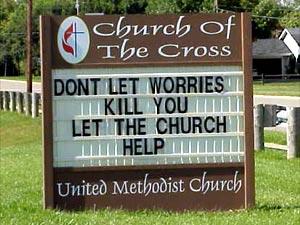
Ah, the delightful ambiguity of the sign.... Anyway, Maggi Dawn commented yesterday: "One of the characteristics of the 'Emerging' mindset is to think of church travelling outwards, rather than expecting people to 'come to us'. I like this idea best when it's accompanied with a Bonhoeffer understanding of the world - not that we 'take God out' to the world, but that we engage with God 'out there' instead of having a retreat mentality."

It's also important to be reminded (as the reference to a mid-twentieth century pastor and theologian tells us) that creative thinking about the church and the vocation it seeks to embody does not automatically derive from, or depend upon, new thinking. There is much that is new and reactionary (by which I mean fearful and defensive) around at the moment, both in the Christian community and elsewhere. By the same token, it is salutary to discover just how long our in vogue diagnoses have actually been around:

"We as individuals, as a congregation of Christian people, and as members together of the Christian church, can neither enjoy faith in God nor be a means of the kindling of faith in others unless we are ready to receive the grace to live faith as an experiment and an experience. Nothing can establish God. We can hope only to be established by God and in God. We are not in a post-Christian era but we are in a post-Christendom era. Civilization and culture do not take God or Christianity for granted. This puts us back into the situation of the people of God for most of their history, certainly into the position of the New Testament church and of the church of the first creative centuries. The world does not help us to believe in God nor do we strengthen our faith through conformity... This does not mean, however, that we are to withdraw into the church and seek somehow to cultivate our faith with our backs to the world. Such church-centredness can only be the death of faith. God is to be found in what [God] makes of the world and of God's people for the world. It is abundantly clear from the Bible that God's people always lost their living faith in the living God when they supposed that they themselves were the focus both of God's activity and of God's reality."
(From David E. Jenkins, on 'Christian Faith in God', written in 1968 - from the collection Still Living With Questions, SCM Press [My emphases].)

That just about sums it up. To be grasped by who and what God might be (beyond our manipulations of 'god') is not a license for retreat, fantasy or the abrogation of reason; rather it is to exercise a traditioned trust which makes adventure, questioning and exploration essential. And it is made possible only by a church-turned-outwards.

Comment on this post: FaithInSociety

Sunday, October 16, 2005

[215.1] FACE-TO-FACE WITH THE CULTURE OF RACISM

A number of commentators and webloggers have reacted with understandable distress to the news about the racist abuse which greeted the appointment of Britain’s first black archbishop, Dr John Sentamu (left). As Maggi Dawn said: "not unprecedented, but still disgraceful." The UK may be a broad society, but it is also stalked by what social psychologists call heterophobia – fear of 'otherness'. That, at root, is what racism, in both its personal and institutional guises, is about.

So how can it be challenged? Back in 1997 I was co-organising an ecumenical conference in Scotland, for which the main speaker was the extraordinary Vincent Donovan, the pioneering Catholic priest and author of Christianity Rediscovered: An Epistle from the Masai. At that time Donovan, getting on in life and physically very vulnerable, was still working part-time as a chaplain to university students in North Carolina. As he commented, many of the whites there had imbibed the entrenched racial attitudes of the Deep South rather thoroughly.

Donovan went on to tell the story of how he passed a group of white, male youngsters cursing and bad-mouthing black people. He stopped and asked them why. “Because they're all filthy, stinkin’ thieves”, they replied. Donovan asked: “Who told you to think like that?” They looked offended. “No-one. That’s what we know for ourselves”. Evidently oblivious to his own safety (in a way that becomes quite believable if you meet him in the flesh) Donovan declared: “Nonsense! You're basically decent kids, and you're coming out with this garbage. I don’t think you came to the conclusion that 'black people are bad' all by yourselves, with no encouragement. I bet that's exactly how your families and friends think, too. What you’re doing is just following their lead and fitting in with those you hang out with. So why don’t you become real men by starting to think for yourselves? Look, there’s a group of black people… let’s go find out what they’re really like and what they think of you.” They white youngsters were, by all accounts, a bit astonished to be challenged in this way, and a robust but friendly dialogue ensued.

It’s a wonderful example of what you might call holy foolishness, and a reminder not just about the significance of having the courage of our convictions, but also about the crucial fact that racism and xenophobia, in common with all alienations, is a matter both of cultural production and of inter-personal formation. Like me you may doubt whether you have bravery to face it out in the same way as Vincent. I recall reasoning at the time (in a self-serving and not entirely rational way) that a quirky, feisty old geezer would surely be much less vulnerable to assault than those of us who might make better sport. Maybe, maybe not. But what we (I) can’t avoid is the reality that cultures of exclusion and hate (including the church's fashionable homophobia) are fed by collusion and can only be changed by hopeful realism, both personal and political.

Comment on this post: FaithInSociety

Monday, August 29, 2005

[167.1] LEARNING TO FOLLOW MY LEADER?

I have been wondering for some time about what it might mean for there to be a correlative to ‘leadership’ called ‘followership’, and if so how the former might be rescued from the unwanted imposition of individuated power and the latter from the mere self-encoding of patterns of domination.

This is a matter of importance to me for two reasons. First, because most of the time in life we are, whether we reflexively know it or not, followers; but sometimes we become leaders. And in both instances we are ill-equipped by the dominant discourses of our age to discharge these functions in ways which could be genuinely described as hopeful and liberative. Second, because, as a Christian, I am caught up in the multiple meanings of Jesus’ “follow me”, since I have discovered in the Way of Jesus a subversive authenticity which makes the path of discipleship (well realised by someone like Bonhoeffer, poorly realised by someone like me) a necessity for re-understanding and re-engaging the world in which I find myself. (Questions surrounding Pope Benedict XVI and the assumptions of Christendom are not irrelevant here, either.)
To put it differently, in seeking ways of following Jesus as Christ today, what I experience is not capitulation to ‘foreign occupation’ or the reduction of myself to some sheep-like docility, but rather a re-awakening, a disturbance and an (often painful) opening. But why is this so? And what could it mean for (say) the re-consideration of ‘religion’, the re-description of ‘secularity’, the re-expression of church and the re-doing of institutional life in a complex, urban culture?

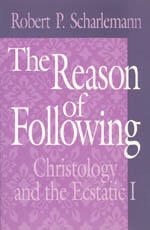
For these and many other reasons, I have on my ‘must read’ list Robert P. Scharlemann’s The Reason of Following: Christology and the ecstatic I (University of Chicago, 1991), of which there is a small preview here. I have recently been reading the same author’s Inscriptions and Reflections: Essays in Philosophical Theology (University Press of Virginia, 1989), which I picked up at Unsworths Bookshop earlier in the summer during a sojourn in London. It’s fantastic. Scharlemann opens up new possibilities for understanding Christian formulae in the contemporary by re-understanding theology as what he calls an “afterthinking” (metanoiesis) based on the inversion of traditional ontology.

Anyway, in The Reason of Following, Scharlemann suggests that Christology represents a form of reason and an understanding of selfhood. To quote the blurb, he traces “the connections between the ‘I am’ of the God who spoke to Moses, the ‘I am’ of Christ, and the ‘I am’ of autonomous self-identification. How, he asks, can the self that spontaneously responds to Jesus’ ‘Follow me!’ be compared with the everyday, autonomous self? What is the nature of ‘following’ on the part of those who answer the summons of one whose name is ‘I am’?

“Pursuing these questions, Scharlemann develops a Christological phenomenology of the self – an account in which following means not the expression of the self in action or reflection but rather self-discovery in another person [emphasis added].”

“With a deep sense of both culture and philosophy, Scharlemann [also] distinguishes the forms of reason involved in ‘following’ from those in ethics, aesthetics, and other modes of religious philosophic thought. His … readings of nineteenth- and twentieth-century German theological and philosophical traditions provide an introduction to lesser-known thinkers such as Hermann and Picht as well as a profound critique of major figures such as Descartes, Heidegger, Fichte, and Kant.”

“Finally Robert Scharlemann outlines a program for a more systematic and rounded presentation of what Christian doctrine might mean in the contemporary world.”

Sounds fascinating, and an important preparation for immersion in management speak, organisational theory, leadership studies, change agency, and all the other disciplines that presuppose those patterns which theology properly seeks to unpick and re-weave – theology being, as Charles E. Winquist once put it, a “nomad discipline” which is a work against “the disappointment of thinking.”

Comment on this post: FaithInSociety

Tuesday, December 19, 2006

[374.1] LOOSENING CHRISTIANITY FROM CHRISTENDOM

In a recent article about 'the Christmas wars', Giles Fraser observed: "The distinction between Christianity and Christendom is not widely understood." He's right. Whether we are Christians or not, our whole way of thinking about God, the church, theology and the subversive narrative of Jesus is still imprisoned in the functionalist assumption that Christianity is, or needs to be, an essentially 'established', 'recognised', 'buttressed' or 'majority' faith. Privileged in the social, cultural, political and economic order, in other words. It is this that produces the "either it must be imposed or it must be deleted" approach to religion in public life beloved of putative dogmatists on all sides.

But the alternative, post-Christendom possibility is catching on, not least because of dramatic changes in church and society. Around as a public argument at least since the time of Kierkegaard, the critique of Christendom as the dominant ideology of faith is (very) slowly starting to edge into contemporary conversation and commentary. It is hinted at in Frank Furedi's penetrating piece Do they know it's Christmas?, and it was also effectively recognised by Brian Walden (coming from a rather different place on the political spectrum) in his weekend BBC Radio 4 A Point of View broadcast - although he used the less helpful - because confusing - term post-Christian, which precisely assumes that Christianity depends upon power and status.

Now here's former Iona Community leader Ron Ferguson, writing in the Scottish newspaper The Herald, and hitting the nail firmly on the head: “The reality is that Britain is no longer a Christian country – the term is a piece of fantasy anyway – and fewer and fewer people go to church. What we are witnessing in western Europe is the end of Christendom – the cultural, if not constitutional, alliance between church and state. I've yet to be convinced that this particular demise is something that should be mourned.”

For it is surely the divinely disruptive and levelling spirit of Iona's wild goose, not empires and temples, which is needed to sustain the radical message of the community of Jesus in the 21st century? This is what it means to pay homage to the Prince of Peace, rather than principalities and potentates. "Not my might, not by power, but by my spirit, says the Sovereign One." It's a difficult vocation to live when the logic of compulsion is all around us - in both its 'religious' and its 'secular' guises (none of which are nearly so religious, or secular, as they like to claim).

Comment on this post: FaithInSociety

Friday, August 10, 2007

THINKING OUT OF THE STORM

Two days ago I was discussing with a friend what might be an appropriate title for a new church study and reflection group here in Exeter. Soundings came to mind, because its maritime metaphor connotes both a commitment to unbounded intellectual curiosity, and the recognition that in order to plumb the depths we need some kind of anchorage in turbulent times - a hybrid notion which acts as a suitable antidote to two fashionable but misplaced intellectual trends.

The first is the idea that there can be such a thing as un-traditioned, wholly autonomous thought (this fails to recognise the true debts we owe when we try to think freshly, and the need to build a reflexive account of these into what we offer). The second is the idea that 'tradition' is inherently about fixity in method, scope, reference and interpretation (which fails to acknowledge the diversity and dynamism of what we inherit, build on and modify).

In terms of theology (the articulation and exploration of Christian hope in reasoned discourse) Ken Leech comments well on this in the fourth part of his Samuel Ferguson Lecture 2006 given at the University of Manchester on 19th October 2006 (The Soul and the City: Urban ministry and theology 1956-2006). Cultivating a constructive "abnormal discourse" - in the sense he evokes from Rorty - is certainly the kind of approach we are committed to on Ekklesia. Not least because the conventions surrounding the discussion of religion at the moment, both anti- and pro-, are so stiflingly inadequate and forgetful.

"Theology begins to change when the ground on which we stand begins to crumble, or, to change the metaphor, when we find ourselves in the midst of violent storms. This was how many Christians, not least in the urban areas, experienced the 1960s. The sense of turbulence in theology was expressed memorably by the Chicago-based theologian Langdon Gilkey in 1965.

The most significant recent theological development has been the steady dissolution of all those certainties, the washing away of the firm ground on which our generation believed we were safely standing. What we thought was solid earth has turned out to be shifting ice -- and in recent years, as the weather has grown steadily warmer, some of us have, in horror, found ourselves staring down into rushing depths of dark water. (Gilkey 1965).

"It was not surprising that a number of the influential writings of this period were inspired by Paul's navigational escapades recorded in
Acts 27. Soundings, edited by Alec Vidler, was followed by Four Anchors from the Stern and Praying for Daylight, while the inimitable Eric Mascall contributed his Up and Down in Adria.

"However, this encounter with turbulence has led to new creativity, new approaches, new insights, new methods of working which have served to liberate, to break the mould, to challenge and subvert accepted ways of working.

"How does this occur? Clearly it is not inevitable. (Many Christians, confronted by storm, cry out, 'Hide me , O my Saviour, hide / Till the storm of life is past'!) A clue lies, I believe, in the notion of 'abnormal discourse' described by Richard Rorty in his Philosophy and the Mirror of Nature. Rorty argues that much discussion and thought runs along predictable lines, based on certain accepted conventions. Abnormal discourse is 'what happens when someone joins in the discussion who is ignorant of these conventions or who sets them aside. . .The product of abnormal discourse can be anything from nonsense to intellectual revolution, and there is no discipline which describes it, any more than there is a discipline devoted to the study of the unpredictable or of 'creativity' (Rorty 1980: 5, 320-1).

"I believe that much of the progress in recent urban theology has come from such abnormal discourse, supported by abnormal practice, which over time has become normal and common."
[Pic: Kenneth Leech]

Sunday, January 06, 2008

NOSTALGIA, CHRISTENDOM AND POWER

Bishop Michael Nazir-Ali of Rochester has stirred quite a reaction with his provocative article in the Sunday Telegraph arguing that Islamic extremism has made some areas of the country effective no-go areas (something many on the ground see as both a misrepresentation and a self-fulfilling prophecy) and that Britain's status as a 'Christian nation' led by an Established church is being eroded (which I have argued is a positive rather than a negative).

Third Way magazine (for whom I do a monthly Westminster column) will be publishing an extended interview with Dr Nazir-Ali (pictured) shortly - so this will set them up nicely. Actually, I was invited to consider being the interviewer, but I declined, because the aim of these 'High Profile' features is to get people to talk about their influences, and I was not sure I would be able to resist getting into a debate! My view of what he says is also conditioned by the fact that I know +Michael a bit. We first met when he became general secretary of CMS in 1989 (I wrote and edited their annual review that year, working as a freelance journalist), and then renewed acquaintance through the Mission Theological Advisory Group of CTBI and the Church of England (he was chair and I was a staff associate). I think we last met in mid-2007 during a public discussion about religion and society filmed in London by Premier Radio. I've always had great respect for him on a personal basis, though he seems to have moved towards ever more entrenched views over the past five years, and obviously I disagree with him strongly regarding his assessment of Establishment, 'Christian Britain' and what one might call the mixed-belief economy of modern Britain.

What we need right now is not Christendom revanchism (an impossibility anyway), but the rediscovery of a Christian vision which is self-sufficient enough not to need to prop or be propped by the state, open enough to engage with others on equal terms, historical enough not be fall prey to nostalgia, and subversive enough to recognise that the Gospel is about overturning the status quo rather than wanting to be its lynch pin. This is not an easy or even task, given the resurgence of fundamentalism, various "moral panics", the polite corrosions of civic religion, public indifference, establishment clericalism and the temptations of a rootless form of liberalism which mistakes hopelessness for open and critical enquiry. But success is not a promise to followers of Jesus. The rather different call to costly discipleship is.

In many respects I am more and more drawn towards the seemingly austere conclusion of Alasdair Macintyre's classic After Virtue, which suggests that in a hostile environment small communities of civility and virtue can chart a genuine way beyond the 'new dark ages' that may already be upon us. Superficially that sounds pessimistic, but it is not. It is realistic, given the state of the world, its environment, its religion and its politics. It is about investing in consistent, small-scale hope rather than falling for romanticm, Hobbes, Machiavelli or the illusions of power.

Friday, November 10, 2006

[347.1] THE WHITE POPPY BLOODBATH

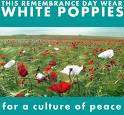
Well, not quite - but the idea that we might think about peacemaking and nonviolent symbols alongside war remembrance has been variously described to me (in a string of media interviews yesterday, from BBC to TalkSport to Vatican Radio) as 'unacceptable', 'barmy' and 'despicable'. But the notion that this means the assumptions of the existing set-up must therefore be at least implicitly pro-war does not really register. It is a huge blind-spot. But not unexpected.

Ekklesia's proposal (I quote from our news release) was that "Whether you are from a 'Just War', or a pacifist tradition, Christians believe that there is no redemption in war. Churches, who host so many services of remembrance, should at least give people the choice, and make white poppies more widely available, alongside red ones." Both The Times and the Express 'interpreted' that as a call to "dump" or displace the red poppy with a pacifist white one. And these are the people who read and write English for a living... Ah, well.

At least The Sun got it right! Ye, of little faith... The Google News feed on the coverage (a lot of it) is here. And yes, we have raised questions about whether the red poppy is really 'neutral'. The violence of the reaction would, ironically, undermine the case that it isn't. And the official Poppy Appeal site quotes Admiral Lord Nelson: "England expects every man will do his duty." That, in case you didn't know, was about forming conflict resolution teams. Ahem.

The material which will tell you what we are really saying is here, by the way: Proper debate about war 'honours those who have died' 9/11/06; Violent solutions not 'normal' but mythic, says theologian 09/11/06; Challenge to political correctness of the poppy 09/11/06; Canadian war veterans attack peace activists over white poppies 08/11/06; Controversy over sale of white poppies. More on the roots of the "myth of redemptive violence" here. Walter Wink is Professor of Biblical Interpretation at Auburn Theological Seminary in New York City, USA. His books may be purchased at Metanoia Books. To buy white poppies: http://www.whitepoppy.org/; British Legion appeal: http://www.poppy.org.uk/givemoney.cfm.

Meanwhile, here's a newspaper letter I was invited to send back to a correspondent who had got very much the wrong end of the stick, but also wanted to accuse us of being Hitler-appeasers.

Ekklesia has not called for red poppies to be"dumped". We have suggested that churches can make white ones available alongside them, to remind us that the dead are honoured when we commit ourselves to alternative ways of resolving conflict.

We cannot remake history, but we can learn from it. The Second World War defeated Hitler, but the First and its aftermath produced him. Latterly, largely nonviolent means overcame entrenched tyranny in Eastern Europe and South Africa. But war in Iraq, while removing Saddam, has resulted in worse bloodshed, not a 'solution'. Meanwhile the 'war on terror' is reinforcing what it fights.

TV culture constantly conveys the dominant assumption that killing solves problems. But it is might that wins wars, not right. Our point is that the the poppy and the Cross are symbols of death, but while the former implies that violence can deliver us, the latter declares the power of love to be non-violent sacrifice.

Ekklesia supports the difficult work of conflict transformation in war zones. We think this is where the priority should be right now (especially for the churches, who often seem more interested in-infighting). That is a fine way to honour those who died in the hope of an end to war, but whose dreams are not being answered by its perpetuation across the globe.

Comment on this post: FaithInSociety