GORDON BROWN AND 'DOING GOD'
How will Gordon Brown keep the faith? (Ekklesia).
The new British Prime Minister will be less overt in his faith agenda and less establishment in his church instincts, suggests Simon Barrow. But religion and public life will remain hot political issues.
Tuesday, July 31, 2007


Monday, July 30, 2007
HARRY POTTER AND THE FEVERED IMAGINATION
'Reading Harry Potter too religiously' - Ekklesia culture and review section.
Religiously constructed rows over sorcery, metaphor and meaning in Harry Potter are hardly new, as Simon Barrow has personal reason to know. He suggests we all chill out and finding meaning not menace in the narrative. (Which he probably won't read, by the way).
INSPIRED AND OFF-CENTRE
She is a guide and provocateur for atheists and Christians, for revolutionaries, recidivists, romantics, and realists; for religious and non-religious; for philosophers, factory workers, sociologists, cooks and truck drivers. “In France”, declared the New York Times, “she is ranked with Pascal by some, condemned as a dangerous heretic by others, and recognised as a genius by all.”
 For Andre Gide she is “the best spiritual writer of the twentieth century.” And T. S. Eliot, whose conservative political and ecclesial outlook was in many respects the opposite of hers, concluded: “We must simply expose ourselves to the personality of a woman of genius, or a kind of genius akin to that of the saints.
Truly, Simone Weil (1909-1943) has a unique voice which needs to be heard again in the twenty-first century – a supposedly ‘post ideological’ era in which views and ideas are hardening in spite of (or perhaps because of) cultural diversity, spiritual confusion, secular angst and social fragmentation.
Weil was, in many respects, a disturbed person who lived life in fragments. Yet there is an unsettling wholeness to her vision which offers connectedness without uniformity, spirit without dualism, rebellion without inhumanity, nourishment without gluttony, and God without illusion.
Perhaps the best place to start with her work is Gravity and Grace, Simone Weil’s first ever publication. This is now available from Routledge in an edition which includes not just a foreword by friend, interlocutor and interpreter Gustave Thibon, but also a postscript he wrote in 1990 and which was published in English for the first time in an edition re-issued in 1999.
Stephen Plant, who I had the pleasure of working with through the international committee of Churches Together in Britain and Ireland, has written a short introduction to Simone Weil (as well as one of my other lode stars, Dietrich Bonhoeffer) – one which is both appreciative and honest.
Reading Weil will always leave you unsettled at one level. But also inspired. It will not leave you unchanged. She is an eccentric in the technical (rather than purely pejorative) sense of the word: off-centre - when 'centre' is understood to mean "dominant ideas and ways of life".
“Our life is impossibility, absurdity. Everything we want contradicts the conditions or consequences attached to it. Every affirmation we put forward involves a contradictory affirmation. All our feelings are mixed up with their opposites. It is because we are a contradiction – being creatures – being godly and infinitely other than God… Impossibility is the door of that which is beyond nature. We can but knock at it. It is someone other who opens.”
[translation by the author – for Mary Metzler]
Sunday, July 29, 2007
LEARNING TO LIVE IN HOPE
“Hope is believing in spite of the evidence, and watching the evidence change.” (Jim Wallis)
“ 'Til everything's right, we ain’t here no more” (Jake Krieder, quoted by Mary Metzler - describing it as a 'Zen Mennonite' kind of statement!)
“History belongs to the intercessors, who invoke the future into being” (Walter Wink)
“We do well to remember that we are human beings, not just human doings” (Eric Fromm)
"It takes no courage to be an optimist, but it takes a great deal of courage to have hope" (Jonathan Sacks - thanks to Alison Goodlad for this one, from The Dignity Of Difference. See also his To Heal A Fractured World)
 Antonio Gramsci, for whom I have great respect, is famous for commending an attitude to life which he summed up as “pessimism of the intellect and optimism of the will.” This sparked an exchange between the German humanist-Marxist philosopher Ernst Bloch (whose classic Der Princip Hoffnung, 'The Principle of Hope', was later translated into English by my friend Stephen Plaice) and the political theologian Jurgen Moltmann (best known for his A Theology of Hope). They agreed that ‘hope’ and ‘optimism’ are not the same thing.
At least as a cultural phenomenon, optimism is the haphazard trust in the idea that things will somehow work out. Hope, on the other hand, is an active commitment to seek out and practice the good, the just and the true in situations of seemingly intractable wrong, injustice and falsehood – knowing that to succumb to an emaciated version of ‘reality’ is to decide in favour of non-change and to distort ‘realism’.
Whereas the world is, we discover as we explore it, a process of inexorable change, encapsulating both growth and decay, renewal and degradation, life and death. Similarly, John Macmurray is right to claim that Descartes would have been nearer the truth to say “We act, therefore we are” instead of “I think therefore I am”.
In this context, to believe in the necessity of God is not to posit some ‘supernatural addition’ to the world, but to recognise in the world process, where God is given in excess or not at all, that what is essential stasis (hatred, killing, intellectual rigidity, social fixity) cannot have the final word. For such things have no word to speak, only words to deny.
God is not “finished being”, such as we are, or rather imagine ourselves to be. Instead, God is better thought of as endless potentiality ranged against the kind of human arrogance that improbably imagines it has adequate grounds, in the frame of this life, to decide what the full-stop is and where it comes. In that realisation resides true hope.
The kind of atheist that the later Jacques Derrida was, and the kind of Christian believer I seek to be, are united in this conviction about “refusing the full-stop”. The kind of believer that Jerry Falwell was, and the kind of atheist that Richard Dawkins is, seem to have decided otherwise, on the grounds of two incompatible certainties which I find equally non-compelling.
They are, I recognise, options. Just not ones I find either rational or faithful. [Picture: Jurgen Moltmann]
Saturday, July 28, 2007
AGAINST THE GRAIN OF THE TEXT
This from former Archbishop of York Dr John Habgood, reviewing an excellent new collection of essays for the Times Literary Supplement - Duncan Dormor and Jeremy Morris, editors, An Acceptable Sacrifice? Homosexuality and the Church, SPCK Publishing. p/b, 190pp., £12.99.
 The Bible is frequently claimed to be unequivocal in its condemnation of homosexuality. While there are texts which might at first sight give the claim some credibility, it is clear from reading them in context that they are not actually answering the kind of questions which today’s protagonists on both sides want to ask. There are many twenty-first-century questions which could not even be asked in biblical times, because the concepts which underlie them, that of homosexual orientation for instance, did not then exist. There is also an important sense in which the Bible is not a book of answers at all. It is a description of, and invitation to enter into, a historical process through which, it is claimed, the nature of God has been progressively revealed. Furthermore, the key ethical insight which forms the culmination of the entire story is the revelation of God as love. To extract a number of texts purporting to be about homosexuality, and to condemn a whole group of people for a personality trait which is not of their making, may look at first sight like faithfulness to the biblical text. In reality it is not to treat the Bible seriously, through failing to take account of its ultimate message about the sovereignty of love and the process by which this came to be.
That such formerly mainstream (and, frankly, pretty conservative) views of Scripture are now being viewed as wild radicalism in some sections of the Anglican Communion and elsewhere, shows just how far things have moved in recent theological debate - and how entrenched current antagonisms are. An Acceptable Sacrifice? suggests some constructive ways forward beyond the unedifying shouting match we now have. As David Paisley observes: "Much of the content is framed as a question or situation to be explored, rather than territory to be defended. That's refreshing in its own right."
Friday, July 27, 2007
A CLIMATE OF CHANGE
At this year’s WOMAD world music festival (27-29 July 2007) UK-based international development agency Christian Aid is asking visitors to join its 'Climate Changed' campaign as they listen to acts from developing countries which are struggling to adapt to the devastating effects of climate change.
Nazmul Chowdhury from Practical Action in Bangladesh, said: "Forget about making poverty history. Climate change will make poverty permanent."
More information here. [Picture: Cut The Carbon walk laces]
At this year’s WOMAD world music festival (27-29 July 2007) UK-based international development agency Christian Aid
 is asking visitors to join its 'Climate Changed' campaign as they listen to acts from developing countries which are struggling to adapt to the devastating effects of climate change.
Nazmul Chowdhury from Practical Action in Bangladesh, said: "Forget about making poverty history. Climate change will make poverty permanent."
More information here. [Picture: Cut The Carbon walk laces]
Thursday, July 26, 2007
LIFE, FOR ART'S SAKE
"Art is a birth, and you can't go to a teacher and find out how to be born... you have to struggle... until that image, the one that comes out of your need to create, emerges." ~ Malcah Zeldis, 1978.
"You don't make it with your hands. You form it with your hands. You make it with your mind." ~ Edgar Tolson, 1971.
Tuesday, July 24, 2007
VOICES FROM THE MARGINS
Someone has asked me how my encouragement of putative bloggers was going. Well, I sent the link to four people (three female, out of interest). So far it has been one 'sorry, no', two heavily qualified 'maybes' and one yet-to-reply. I'm not giving away any secrets, but let's just say that my theory about how blogging is predominantly gendered are being borne out. But of course, there are people I have inexcusably overlooked; who I really would have sent it to if I had thought. (That's the danger of advertising your intentions. Everyone can see you goof.) Like Doug Hynd, from the Anabaptist Association of New Zealand and Australia, for sure. He has recently started Subversive Voices. I'm about to add it to my roll.
Someone has asked me how my encouragement of putative bloggers was going. Well, I sent the link to four people (three female, out of interest). So far it has been one 'sorry, no', two heavily qualified 'maybes' and one yet-to-reply. I'm not giving away any secrets, but let's just say that my theory about how blogging is predominantly gendered are being borne out. But of course, there are people I have inexcusably overlooked; who I really would have sent it to if I had thought. (That's the danger of advertising your intentions. Everyone can see you goof.) Like Doug Hynd, from the Anabaptist Association of New Zealand and Australia, for sure. He has recently started Subversive Voices. I'm about to add it to my roll.
JUST DRINKING... AND MORE
"Give beer to those who are perishing, wine to those who are in anguish; let them drink and forget their poverty and remember their misery no more. Speak up for those who cannot speak for themselves, for the rights of all who are destitute." Proverbs 31.6-8.
(Thanks to Sarah Hill for mining this delightful take on human dignity, a good bit of imbibing and the search for social justice).
Saturday, July 21, 2007
WHAT GENE SAID TO ROWAN
This from an interesting sermon on the Good Samaritan by Bishop Gene Robinson of New Hampshire. About whom many people only know that he is gay, it seems. Hopefully Rowan Williams knows a bit more now. But he still won't invite him to the Lambeth Conference 2008.
 A little while ago, in the only time that the Archbishop of Canterbury ever deigned to see me, we were having a little "chat", and at one point in our conversation, he was explaining to me that, actually what The Episcopal Church should have done prior to electing and consecrating me, was that we should have figured all this out theologically and intellectually... We should have come to a common mind, and then passed canons and and then done this thing. And I said to him with as much respect as I could, "Your Grace, it seems to me that all of the great steps that [the Church] has taken, have been as a result of our doing the right thing, and only then, "thinking" our way to what we did. It's not the other way around. I mean, if we had waited for instance in this country for everyone to have been on the same page about civil rights, there would still be separate drinking fountains, wouldn't there? And if we had waited until women were valued as equal and full members of society and the human race, for goodness sakes, all of that discrimination would still exist."
[Photo: Bishop Gene Robinson]. Thanks to The Religious Left for this snippet.
LIVING BEYOND DEATHLY FEAR
In his fine book ‘Search for Reality in Religion’ (1965, re-issued 1984), which I have been re-reading recently, the personalist Quaker philosopher John Macmurray writes: “[Removing] for ever the fear of death… is a tremendous gain in reality; for until we reach it – however we reach it – we cannot see our life as it really is, and so cannot live it as we should.”
 He continues: “The fear of death is the symbol in us of all death; and fear is destructive of reality. It is true that one can gain this familiarity with death and use it falsely. We can say, as so many of my contemporaries did after the war, 'Let us eat and drink, for tomorrow we die.’ But it may well lead us to the opposite conclusion. We may feel that life is precious because it is short; and because it may end at any moment we must live so that every day would be a good day to die in, if death should come. Without this knowledge of death… there can be no real knowledge of life and so no discovery of the reality of religion.”
I have written a longer piece for Ekklesia which explores this theme in relation to religious violence and the Gospel. It is called Re-evangelizing the religion of death.
Incidentally, Macmurray - a non-believer and soldier who became a Christian, Quaker and pacifist - was one of the finest philosophers of his generation. He was also a committed democratic socialist. Ironic, some would say, that Tony Blair cites him as a formative influence, along with the equally unlikely (from a Blairite perspective) radical Anglican Catholic, Kenneth Leech. (You there, Ken?).
The person who pointed me in the direction of Macmurray, incidentally, was the late Alan Ecclestone, dissident priest and writer on prayer. A wonderful man. See Tim Gorringe's tribute and exposition of his life. [Pic: John Macmurray, (c) the JM Fellowship]
Friday, July 20, 2007
A NEW WORLD SINGING
An absolutely wonderful poem by Niyi Osundare [note that this is (c) the author, with grateful acknowledgement]. From Selected Poems 1992, a verse which is appearing on London underground trains. Talk about an oasis in the desert...
I sing of Change
I sing of the beauty of Athens
Without its slaves
Of a world free of kings and queens
And other remnants of an arbitrary past
Of earth
With no sharp north
Or deep south
Without blind curtains
Or iron walls
Of the end of warlords and armourers
And prisons of hate and fear
Of deserts
Treeing and fruiting
After quickening rains
Of the sun
Radiating ignorance
And stars informing
Nights of unknowing
I sing of a world re-shaped.
Wednesday, July 18, 2007
GETTING STUFF INTO PERSPECTIVE
There is a powerful, personal piece from my valued friend Deirdre Good on Ekklesia (with acknowledgments to the excellent Episcopal Cafe), about suffering, God, blame, prejudice and the difficult need to let go of our desire to be 'in control' - both rationally and spiritually.
 Stuff happens. Accidents. Mental illness. Death. Throughout human history, people have asked "Why?" To ask "why" is to presume that stuff happens for a reason, that behind events lie causes we can discover. It's a question from a privileged perspective. It suggests human omniscience...
Jesus' disciples, seeing a person blind from birth and wanting an explanation for his condition, asked, "Rabbi, who sinned, this man or his parents, that he was born blind?" Jesus' reply shatters the snare of looking at illness as cause and effect: "It's not that this one sinned, or his parents, but that the works of God might be manifest in him." Stuff happens, Jesus says. There's not necessarily a reason for it. Put the emphasis elsewhere. It's not what happens but what you do with what happens that matters.
See the full piece here.
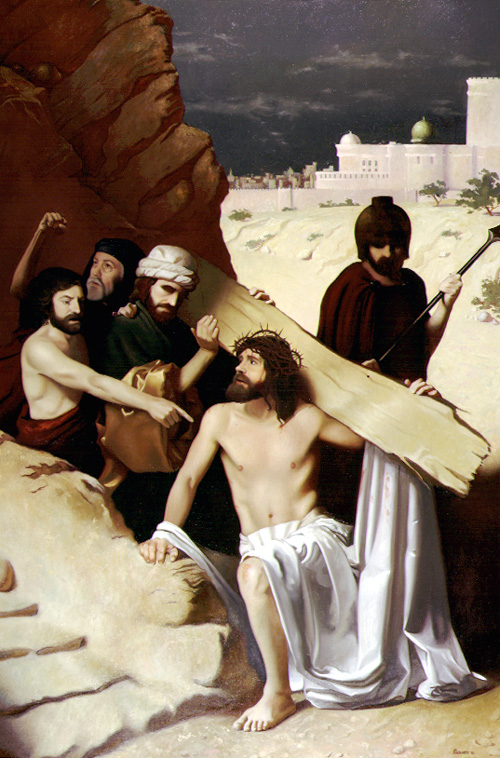
The same theme from St John is picked up in Rowan Williams' powerful and arresting post 9/11 reflection, Writing in the Dust (Hodders, 2001). It's a small essay (about 8,000 words) which merits re-reading in today's continuingly fearful climate. It connects the 'big issues' in life with those small human gestures, attititudes and responses which count more than we can ever know. [Pic: The Way of Suffering, (c) the Gandy Gallery]
Tuesday, July 17, 2007
THOUGHTS FOR SOMEONE WHO COULD BE TEMPTED TO BLOG
There are a couple of people out there who faithfully correspond with me and often make my day with the things they say: wise, funny, insightful or just very, very human... in the best sense of that term. (The guy who was vile to a shop assistant yesterday was also being human, but in a less helpful mode). Anyway, when I read my friends' e-pistles, I often think, "I wish so-and-so could see that!" Of such things are blogs made. Well, the ones I bother with, anyway. But the people who have the best things to say are often the most nervous, diffident or unsure about actually doing so. Unlike those of us with unblessed assurance. So I'm going to post (below) my virtual advice to someone on the verge of possibly, maybe (who knows?) being tempted into the blogosphere - which Maggi Dawn tells me I am already a member of. And I trust her. She also has a good, first-base definition of blogging: "thinking out loud" about life as it is from where it comes to you.
I shall now email this link to the people concerned so they know it's them. (If it's not you, please don't be offended. I'm a bit absent-minded, as well as being a rubbish correspondent.)
You really should do a blog. In my humble opinion. You write very well, and it is a good way to develop thoughts which others will bless you for (and, given how you are, only curse you for if they are bitter and twisted - which is not your issue or responsibility). Of course it goes without saying that cyberspace is full of ego and nonsense. But there is real spiritual enrichment out there, too. Plus genuine laughter and insight. And we sorely need more of that. The thing is, if you are sharing thoughts and feelings with friends in correspondence and they tell you (like I am right now) that what you say is helpful.... well why not make this available a little more widely - or some of it, anyway? People often say "it seems a bit egocentric to have a blog". True. But it could also be selfish not having one, by the same token. Things are a little more complicated (and a lot easier!) than we sometimes think. Even Buddha non-exists in cyber.
I stress that 'some of it', however. Because I think the contemporary trend to evacuate the vulnerability of the private into a welter of self-justifying public rhetoric (and surface-surfing neuroses) is a disturbing one. We are all threatened by the aloneness that is part of the human condition - and which is the only way we come into and go out of this world. In the cyber-age it is easy to expunge this, to mask it, or to project it onto others without realising. A blog can also be a way of negotiating that personal challenge, interestingly. Not an unimportant task, since much of the shittiness of the world is about people being unable to negotiate their boundaries or do anything other than punish others for their own fear and (or of) failure. This is a chance to turn that stuff into a positive, and to release the creativity and hopefulness which is also often denied, dear friend.
But I'm getting too heavy. None of this means that this there isn't a place for living in the sheer playfulness of the moment. or the ecstasy of the fleeting. Rowan Williams has said that prayer is wasting time with God. Go waste, profligately. Likewise, some of the silliness of the web is just fab. And I greatly admired Davina Macall's wry comment when being interviewed on TV about Big Brother: "The thing with me is that there really aren't that many hidden depths - but there are still loads of still-to-be explored superficialities!" I'm quoting from memory... but going around thinking you need to get points for being 'deep' is the most pathetic thing of all.
As with blogs, one of the reasons I like Facebook (apart from the fact that, it seems, I'm basically a cyberslut) is the fact that you get to see the daft or trivial side of some "serious" people. And vice versa. This is what we rightly call their "human" dimension - since to be human is inherently daft, messy, glorious and weighty: all at the same time. And the blogosphere can hold those together in ways that other media lack. What Simone Weil calls gravity and grace. Though she struggled to reverse those two.
Anyway, if you did decide to dip your toe into blogworld I would happily recommend and link yours to other people I love, enjoy and value. And remember, it doesn't have to be a chore. You can decide to blog regularly (like my friend Johan Maurer's excellent 'Thursday commentaries') You can work it into your routine (like I do, though of 'routine' there is not nearly enough), or you can use it as an occasional cipher and not feel any responsibility for regularity - or lack of it. Not caring too much is an importnat and learnable skill. Blogging is about not being a sausage. Except when you need to be. Or you're a weary pilgrim. Above all, have fun - grow - share - laugh... and discover. Something like that. OK, off for a cuppa. Hope I haven't put you off. Just write the darned thing, OK?!
Now, what was I supposed to be doing? Ah yes...
PS. When I got my first laptop, Carla J Roth - who I have the immense good fortune to be married to - tellingly observed: "Darling, that's marvellous - you never need have another unpublished thought again!" Though I think she borrowed it from Joe Orton, or someone equally droll... I only mention this because she will hate me mentioning it (though not too much). And because she doesn't read this stuff. Do you, dear?
PPS. None of this means that you couldn't be doing something far more useful with your life. But it sure beats shopping.
PPPS. No, of course, I'm not saying that private correspondence should give way to blogging. Heaven forfend! But it's not a zero-sum game. Plus the public can be more personal and the personal more public than we sometimes realise... Both/and. Yes.
There are a couple of people out there who faithfully correspond with me and often make my day with the things they say: wise, funny, insightful or just very, very human... in the best sense of that term. (The guy who was vile to a shop assistant yesterday was also being human, but in a less helpful mode).
 Anyway, when I read my friends' e-pistles, I often think, "I wish so-and-so could see that!" Of such things are blogs made. Well, the ones I bother with, anyway. But the people who have the best things to say are often the most nervous, diffident or unsure about actually doing so. Unlike those of us with unblessed assurance. So I'm going to post (below) my virtual advice to someone on the verge of possibly, maybe (who knows?) being tempted into the blogosphere - which Maggi Dawn tells me I am already a member of. And I trust her. She also has a good, first-base definition of blogging: "thinking out loud" about life as it is from where it comes to you.
I shall now email this link to the people concerned so they know it's them. (If it's not you, please don't be offended. I'm a bit absent-minded, as well as being a rubbish correspondent.)
You really should do a blog. In my humble opinion. You write very well, and it is a good way to develop thoughts which others will bless you for (and, given how you are, only curse you for if they are bitter and twisted - which is not your issue or responsibility). Of course it goes without saying that cyberspace is full of ego and nonsense. But there is real spiritual enrichment out there, too. Plus genuine laughter and insight. And we sorely need more of that. The thing is, if you are sharing thoughts and feelings with friends in correspondence and they tell you (like I am right now) that what you say is helpful.... well why not make this available a little more widely - or some of it, anyway? People often say "it seems a bit egocentric to have a blog". True. But it could also be selfish not having one, by the same token. Things are a little more complicated (and a lot easier!) than we sometimes think. Even Buddha non-exists in cyber.
I stress that 'some of it', however. Because I think the contemporary trend to evacuate the vulnerability of the private into a welter of self-justifying public rhetoric (and surface-surfing neuroses) is a disturbing one. We are all threatened by the aloneness that is part of the human condition - and which is the only way we come into and go out of this world. In the cyber-age it is easy to expunge this, to mask it, or to project it onto others without realising. A blog can also be a way of negotiating that personal challenge, interestingly. Not an unimportant task, since much of the shittiness of the world is about people being unable to negotiate their boundaries or do anything other than punish others for their own fear and (or of) failure. This is a chance to turn that stuff into a positive, and to release the creativity and hopefulness which is also often denied, dear friend.
But I'm getting too heavy. None of this means that this there isn't a place for living in the sheer playfulness of the moment. or the ecstasy of the fleeting. Rowan Williams has said that prayer is wasting time with God. Go waste, profligately. Likewise, some of the silliness of the web is just fab. And I greatly admired Davina Macall's wry comment when being interviewed on TV about Big Brother: "The thing with me is that there really aren't that many hidden depths - but there are still loads of still-to-be explored superficialities!" I'm quoting from memory... but going around thinking you need to get points for being 'deep' is the most pathetic thing of all.
As with blogs, one of the reasons I like Facebook (apart from the fact that, it seems, I'm basically a cyberslut) is the fact that you get to see the daft or trivial side of some "serious" people. And vice versa. This is what we rightly call their "human" dimension - since to be human is inherently daft, messy, glorious and weighty: all at the same time. And the blogosphere can hold those together in ways that other media lack. What Simone Weil calls gravity and grace. Though she struggled to reverse those two.
Anyway, if you did decide to dip your toe into blogworld I would happily recommend and link yours to other people I love, enjoy and value. And remember, it doesn't have to be a chore. You can decide to blog regularly (like my friend Johan Maurer's excellent 'Thursday commentaries') You can work it into your routine (like I do, though of 'routine' there is not nearly enough), or you can use it as an occasional cipher and not feel any responsibility for regularity - or lack of it. Not caring too much is an importnat and learnable skill. Blogging is about not being a sausage. Except when you need to be. Or you're a weary pilgrim. Above all, have fun - grow - share - laugh... and discover. Something like that. OK, off for a cuppa. Hope I haven't put you off. Just write the darned thing, OK?!
Now, what was I supposed to be doing? Ah yes...
PS. When I got my first laptop, Carla J Roth - who I have the immense good fortune to be married to - tellingly observed: "Darling, that's marvellous - you never need have another unpublished thought again!" Though I think she borrowed it from Joe Orton, or someone equally droll... I only mention this because she will hate me mentioning it (though not too much). And because she doesn't read this stuff. Do you, dear?
PPS. None of this means that you couldn't be doing something far more useful with your life. But it sure beats shopping.
PPPS. No, of course, I'm not saying that private correspondence should give way to blogging. Heaven forfend! But it's not a zero-sum game. Plus the public can be more personal and the personal more public than we sometimes realise... Both/and. Yes.
ADVICE FOR DELUSIONISTS
Both those tempted to heroic despair and those tempted to denial in the face of the world's multiple lesions, which Weil embraced with frightening intensity...
"We must not seek the void, for it would be tempting God if we counted on supernatural bread to fill it. We must not run away from it either." Simone Weil, Gravity and Grace, p 23.
Note to a friend: Do you know Simone Weil? I'm as big a fan of hers as I am of Bonhoeffer. She was way off kilter... the boundary between madness and genius, hope and despair. (The place where those of us who are not trhere should not pretend to be. Which is what she is saying here, I think.)
Monday, July 16, 2007
NOT SIMPLY FEET OF CLAY
"As human beings, we understand the world through simile, analogy, metaphor, narrative and, sometimes, claymation." - Bruce Mason.
(Thanks to Steven Sullivan for this gem, which has been virally marketed through his email signature file for some time, and which comes from a discussion on post-modernism and science on Pharyngula. Not a notably balanced, useful or informed one, admittedly - at least on the philosophy 'side'. But Dr Mason deserves to be canonised for this one... in the literary sense.)
Saturday, July 14, 2007
POLITICS AS THE POSSIBILITY OF THE ARTFUL
Gordon Brown, artfully manoeuvred into Downing Street, will have little room to operate in for his global social justice agenda. But what tiny space there is will be created by the power of imagination and the pressure for change coming from below. Look at the example of Northern Ireland. And global warming, for that matter. There's miles to go, but we wouldn't be anywhere without the influence of civil society and the mobilisation of cyber-influence.
Gordon Brown, artfully manoeuvred into Downing Street, will have little room to operate in for his global social justice agenda. But what tiny space there is will be created by the power of imagination and the pressure for change coming from below. Look at the example of Northern Ireland. And global warming, for that matter. There's miles to go, but we wouldn't be anywhere without the influence of civil society and the mobilisation of cyber-influence.
Tuesday, July 10, 2007
SPEAKING OUT OF THE WHIRLWIND
It is a sad reality that some of the greatest platitudes come out of the mouths of enthusiastic believers, while it is the sceptics who (more encouragingly) get closer to theological wisdom. Correspondingly, the crisis of Christendom - an ecclesial domination system whose interests have often obscured the gospel - has been well understood by a thoughtful minority from Kierkegaard onwards. But not usually by those most enmeshed in church polity. Combining those two thoughts, here is the late English composer Sir Michael Tippett (of whose music and passionate free-flowing artistic humanism I am a devotee), hitting the nail on the head. From among his disparate writings collected in The Age of Aquarius, I believe. Though it might have been Music of the Angels.
"I have .. not the slightest idea where healing will come [from] because the moment of complete dereliction for the Christian civilization has probably not been reached and so the moment of God's voice from the whirlwind has not come. Though perhaps the whirlwind has come! And that is the only kernel of truth I see - that God will be found in the refuse bin as of old - the stone that has been thrown away."
I know I have quoted that before, but it keeps coming back to me with great force. Incidentally, my recently revived and rather eclectic music blog is here. Something to keep life balanced and connected - music, that is. Not necessarily blogging ;)
It is a sad reality that some of the greatest platitudes come out of the mouths of enthusiastic believers, while it is the sceptics who (more encouragingly) get closer to theological wisdom. Correspondingly, the crisis of Christendom - an ecclesial domination system whose interests have often obscured the gospel - has been well understood by a thoughtful minority from Kierkegaard onwards. But not usually by those most enmeshed in church polity.
 Combining those two thoughts, here is the late English composer Sir Michael Tippett (of whose music and passionate free-flowing artistic humanism I am a devotee), hitting the nail on the head. From among his disparate writings collected in The Age of Aquarius, I believe. Though it might have been Music of the Angels.
"I have .. not the slightest idea where healing will come [from] because the moment of complete dereliction for the Christian civilization has probably not been reached and so the moment of God's voice from the whirlwind has not come. Though perhaps the whirlwind has come! And that is the only kernel of truth I see - that God will be found in the refuse bin as of old - the stone that has been thrown away."
I know I have quoted that before, but it keeps coming back to me with great force. Incidentally, my recently revived and rather eclectic music blog is here. Something to keep life balanced and connected - music, that is. Not necessarily blogging ;)
Sunday, July 08, 2007
CHANGE WITHIN ISLAM AND WELL BEYOND
There's a really interesting and important piece in the International Herald Tribune, Only traditional Islam can do it, by Phillip Blond a senior lecturer in philosophy and religion at the University of Cumbria (also an established Radical Orthodoxy luminary) and Adrian Pabst, lecturer in theology at the University of Nottingham.
 What they are essentially arguing for is a strongly tradition-rooted resistance, from among Muslims, to the legitimation of terror within present, politicized Islam. Contemporary Islamic fundamentalism is, they point out, modern and heretical rather than 'traditional' - contrary to the mistaken assumptions of many commentators and a superficial reporting culture. (I think it's inevitably more cloudy than that, but in the final analysis they are right.) So, they write, "given that we are losing the battle of hearts and minds, we would be well advised to chart a different path. By encouraging an Islamic renaissance and reviving traditions that the fundamentalists have so violently suppressed, Muslim youth might be diverted from their present course." By contrast, trying to make Islam less Muslim (as if it was all corrupt, and non-religious modernity is all benign) is unworkable and counter-productive. Read it all here.
This is clearly related to the current news issue of who gets to be imams, how they are formed and equipped, and where they come from. That has actually been a Muslim (and inter-faith) concern for many, many years. And those like Philip Lewis in Bradford, and others, who have tried to get it recognised have often been ignored or misunderstood. So good on the BBC for finally getting there, courtesy of the University of Chester. But the media and government are only just coming up to speed with these things - and they still have no idea about how behind they remain and how much they don't know. Witness, in contrast to Blond and Pabst, Robert Piggott's simplistic meme-transmission that imams just need to be more modern and less foreign if they are to be any good. In other contexts this would be seen as deeply patronising and even racist, and not without warrant.
So I'm essentially in agreement with Blond and Pabst, I think. What will stop Muslims, Christians and other religionists (as well as humanists, atheists and non-believers) from developing into bigots, murderers and haters is not trying to tell them that they must become less Christian or Muslim (say) if they are to be civilized "like us". It is the recovery of deep traditions of compassion within each of these ways of believing, becoming and behaving.
I am really only qualified to talk about Christian faith here, which I am personally convinced offers a vital path to transformation and change - in spite of the distortions and crimes that have often been committed in its name. But the liberating message of the Gospel can only be surfaced by simultaneously identifying and combating the many corruptions of that message theologically (at the core of its intellectual and spiritual imagination). This requires active communities committed to 'the other way' which is, we will discover as we walk it, the way of Jesus in his filial relation to God and others; a way which has been obscured by numerous attempts to co-opt a Christ figure into the designs of imperial religion and the religion of imperialism.
Here I probably have a bit of a different emphasis to my RO friends. It seems to me that their narrative is so over-determined by the "tradition is good, modernity is bad" paradigm, that it is in danger of becoming yet another kind of Romanticism (with a huge Catholic cloak). That is, either a plea by an elite to let them civilize others, or a cosy smoothing of tradition and a dismissive abrasion of the contemporary. I don't think that's quite what they intend, but the presenting rhetoric moves in that direction.
According to St Matthew, Jesus spoke a more interesting, realistic and paradoxical truth about bringing things old and new out of the storehouse. But aren't "new things", by definition, found outside storehouses? Yes and no. It is the courage of deep convictions (ones that can't simply be dreamt up out-of-the-blue by heroic individuals) which enables us to embrace the best of the new, to innovate faithfully, to hope for change, to be grounded as we move into excitingly uncharted territory. (I love the here-and-now, in spite of its many warts, warps and weals!)
But this process is also continually reciprocal. Encountering goodness in the contemporary (think of the rightful pressure of feminism and the women's movement on the patriarchal assumptions of church polity, say) enables us to discover those elements in our tradition (the ekklesia of equals) which were actually way ahead of their time. It's just that we didn't get them. The newness of the kin-dom of God is startling. These 'traditional' recoveries can, in turn, challenge the excesses and corruptions of the present (the idea that either biology or gendered culture are destiny, say, which have been problematics within feminism throughout its history).
To make this kind of thing possible, we need living moral communities (congregations, networks, associations) which are also interpretative communities - those who take conscious and collective responsibility for carrying the past into the future in ways that free us, unite us, and respond to visions of humanity and the world which are enriching, compassionate, non-violent and expanding. This is a massive task, I know. The alternative belief in some round-the-corner political fix, or the temptation to seek a new piety (some current secularism has an unhealthy belief in its own inherent goodness and the evil of that which it contends, say) may look overwhelming.
But, being a Christian, I really do believe that the resources of an unlimited, fathomless, unbargainable, wholly non-competitive love can re-make us and enable us to be re-makers - if we start to help each other behave with the humility and commitment which is, in fact, a true life of prayer. (Prayer means "living beyond our means" as fallible creatures graced by God, rather than people who have to rely just on willpower).
What's depressing is that many Christians appear not to believe this at all, to judge from their public behaviour. They appear to believe that the Gospel somehow warrants them to compel others, to seize 'right' by might, and to defend their interests with every weapon at their disposal. Those convictions are the core of the US religious right, and of the newer UK "we are being persecuted" lobbies, sadly. And their distorted definitions of what is 'right' and what 'interests' really matter are, of course, central to the problem. Jesus suggested that those who seek to defend life to the death end up losing it. 'Christian ideology' fails to see this in any way.
Meanwhile, for all its failings (and I am sure they are many) Ekklesia and its allies are trying to point in a very different direction. I'd like to think that RO are too, but they seem to want to reinvent Christendom. Which is a very bad idea indeed, in my book. I've enjoyed the beginnings of an exchange with John Milbank about this, and hope it can continue at some point. Meanwhile, his Centre of Theology and Philosophy at the University of Nottingham has helpfully put up a link to the BBC Radio 4 Beyond Belief discussion on Christian Socialism which featured John and my colleague and friend Jonathan Bartley. [Picture: East London Mosque]
Saturday, July 07, 2007
THE POLITICAL ART OF THE IMPOSSIBLE
 Thanks to Deirdre Good (specifically her fine blog On Not Being A Sausage) for pointing me in the direction of Daniel J. Mahoney's 'City Journal' review of Vaclav Havel's memoir, To the Castle and Back, published by Knopf. The article explores the twists and turns of his interestingly textured thought. Whether politics can be substantially re-grounded in a notion of what John D. Caputo calls "a passion for the impossible" without a commitment to the transcendent as more than simply notional (otherwise it remains just a re-working of the C19th Romanticism of "the sublime"), is the interesting theological question inscribed (but not really explored) on the body of Havel's work - which commendably takes "doing the truth" - a quirky Johannine phrase, actually - as its datum. In many respects it could be described as the negotiable space between those two overlapping but distinctly different "apostles of the impossible", Jacques Derrida and Jean Luc Marion (q.v. on FaithInSociety).
Mahoney writes: "In his post-1989 books and speeches, Havel [pictured] continued to defend a moral vision of politics that he called “nonpolitical politics” or “politics as morality in practice.” He identified this vision with the demanding but liberating task of “living in truth.” Havel refused to identify politics with a dehumanizing “technology of power,” the notion that power was an end in itself. Instead he defended a moral order that stands above law, politics, and economics—a moral order that “has a metaphysical anchoring in the infinite and eternal.” His speeches as president, many collected in English in The Art of the Impossible (1997), were artful exercises in moral and political philosophizing, enthralling Western audiences."
Subscribe to:
Posts (Atom)