[189.1] LINKING POWER AND RECONCILIATION
More on the Church of England House of Bishops' report on power, violence and democracy post 9/11 (yesterday). The official Church House press release is here. Interesting to compare how they set it out (I almost said 'spun it'!) alongside the major newspaper reports - which basically picked up on the initial BBC trail. (See: the Daily Telegraph's Jonathan Petre, Bishops suggest apologising to Muslim leaders for Iraq war; The Guardian's Stephen Bates, C of E bishops criticise US over foreign policy and war on terror; and The Times' Ruth Gledhill, Bishops want to apologise for Iraq war.)
Bishop Richard Harries' Observer article, How the Church can tackle terrorism is worth checking out, too. He rightly says: "Religion has too often been used to justify illegitimate violence; there is a seed of violence within all religions, including Christianity. There is no way that we in the church can contribute to the public debate without taking this fully into account. At the same time, the churches do have a special mandate from their founder for the work of reconciliation." He goes on to reference the work of Canon Andrew White in the Middle East, and the TRC model.
However, over on Thinking Anglicans, which does a fine job of covering the news bases, Andrew Conway comments: "I am not convinced of the need for a South-Africa-style Truth & Reconciliation Commission in Iraq (and I wish Anglicans would be a little more critical in their attitude to the TRC, instead of treating it as a universally applicable model for conflict resolution), but I am rather taken with the idea that the Western democracies should apologise for their role in supporting and arming Saddam's monstrous regime." [emphasis added]
Comment on this post: FaithInSociety
Tuesday, September 20, 2005


Monday, September 19, 2005
[188.1] BISHOPS, BOMBS AND POLITICAL BALLAST
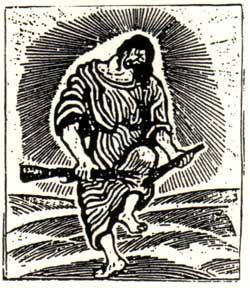 What are we to make of the newly issued 100-page advisory report from the Church of England’s synodical house of bishops, Countering Terrorism: Power, Violence and Democracy Post 9/11 [available as a *.PDF file here]?
As I was attempting to summarise it for Ekklesia, I found myself experiencing mixed emotions: gratitude for a serious, substantial and carefully-crafted piece of work, certainly; irritation that the general media has instantly reduced it to a rather feeble-sounding ‘apology' to Muslims; and concern that even good people atop an Established church inevitably end up side-stepping the difficult peace of Christ in a dubious attempt to establish their credentials as ‘political realists’.
[This is the beginning of a longer comment piece in my Ekklesia column, due up within the next 24 hours.]
Comment on this post: FaithInSociety
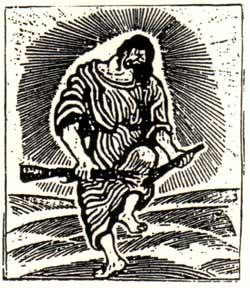 What are we to make of the newly issued 100-page advisory report from the Church of England’s synodical house of bishops, Countering Terrorism: Power, Violence and Democracy Post 9/11 [available as a *.PDF file here]?
As I was attempting to summarise it for Ekklesia, I found myself experiencing mixed emotions: gratitude for a serious, substantial and carefully-crafted piece of work, certainly; irritation that the general media has instantly reduced it to a rather feeble-sounding ‘apology' to Muslims; and concern that even good people atop an Established church inevitably end up side-stepping the difficult peace of Christ in a dubious attempt to establish their credentials as ‘political realists’.
[This is the beginning of a longer comment piece in my Ekklesia column, due up within the next 24 hours.]
Comment on this post: FaithInSociety
Sunday, September 18, 2005
[187.1] A USEFUL REMINDER FROM A NEIGHBOUR
I like your Christ, but I do not like your Christians. Your Christians are so unlike your Christ. (Mahatma Gandhi)
Comment on this post: FaithInSociety
I like your Christ, but I do not like your Christians. Your Christians are so unlike your Christ. (Mahatma Gandhi)
Comment on this post: FaithInSociety
Saturday, September 17, 2005
[186.1] BEHOLD THE WOMAN
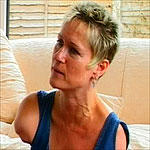
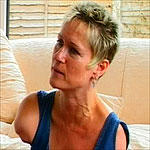
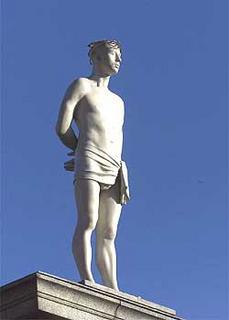 It's curious to witness the minor storm of approval and disapproval provoked by the latest statue to be situated on the famous 'fourth plinth' in London's Trafalgar Square. On 15 September 2005, the striking 3.6m marble sculpture "Alison Lapper Pregnant", by Marc Quinn, was unveiled. Lapper [below, left] is an artist who was born with no arms and with shortened legs due to the chromosomal condition Phocomelia. The statue is a nude representation which intriguingly combines weakness and strength, loss and hope.
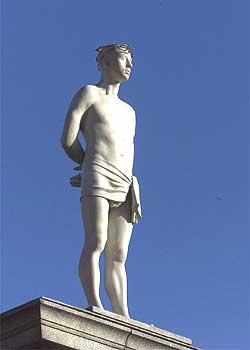
For me it has distinct echoes of Mark Wallinger's remarkable "Ecce Homo" [see picture, left], installed in Trafalgar square July 1999 - February 2000, which is now located in the Anthony Reynolds Gallery (68 Great Marlborough Street, W1). Made of marbleised resin, gold leaf and barbed wire, the unassuming life-size representation of Jesus embodies the vulnerable "man for others" (Bonhoeffer), a definite antithesis of triumphant maleness, postmodern celebrity, modern military heroism, and the unattainable Nietzschean 'superman'.
Marginal to the symbols of power that surrounded it for eight months, "Ecce Homo", like the new Lapper statue, attracts attention to an alternate set of values in proximity to the public square. Wallinger's own philosophy is agnostic, but to my eyes he has created a genuinely faithful representation of what it means to receive Christ as God's person, the one in whom our prevailing corruptions of deity are radically reformulated as solidarity with the victim.
 I doubt that this impression would cut much ice with Stephen Green of the inappropriately-named Christian Voice - an extreme website which seems to have captivated a confused media through its Jerry Springer antics. Green was implausibly asked by The Independent (thanks to MediaWatchWatch for the tip-off) what he thought of "Alison Lapper Pregnant". After damning the venture with faint praise and lamenting the demise of militarism, Green dubbed the sculpture "indecent", childishly observing that "she has her breasts and other bits hanging out."
How sad and revealing that he finds the naked female form threatening and repulsive, rather than seeing in it the goodness of a world gifted by God, the pathos of human disfigurement, and the empowerment of unclothed truthfulness. Like Wallinger's "Ecce Homo", Quinn's tender representation seems infinitely closer the redemptive impact of Christ than the bullying bravado of Christian Voice.
Quinn says: "I'm not physically disabled myself, but from working with disabled sitters I realised how hidden different bodies are in public life and media. [Lapper's] pregnancy also makes this a monument to the possibilities of the future."
"Alison Lapper Pregnant" will be replaced by the "Hotel for the Birds" sculpture by Thomas Schutte in April 2007.
Comment on this post: FaithInSociety
 It's curious to witness the minor storm of approval and disapproval provoked by the latest statue to be situated on the famous 'fourth plinth' in London's Trafalgar Square. On 15 September 2005, the striking 3.6m marble sculpture "Alison Lapper Pregnant", by Marc Quinn, was unveiled. Lapper [below, left] is an artist who was born with no arms and with shortened legs due to the chromosomal condition Phocomelia. The statue is a nude representation which intriguingly combines weakness and strength, loss and hope.
For me it has distinct echoes of Mark Wallinger's remarkable "Ecce Homo" [see picture, left], installed in Trafalgar square July 1999 - February 2000, which is now located in the Anthony Reynolds Gallery (68 Great Marlborough Street, W1). Made of marbleised resin, gold leaf and barbed wire, the unassuming life-size representation of Jesus embodies the vulnerable "man for others" (Bonhoeffer), a definite antithesis of triumphant maleness, postmodern celebrity, modern military heroism, and the unattainable Nietzschean 'superman'.
Marginal to the symbols of power that surrounded it for eight months, "Ecce Homo", like the new Lapper statue, attracts attention to an alternate set of values in proximity to the public square. Wallinger's own philosophy is agnostic, but to my eyes he has created a genuinely faithful representation of what it means to receive Christ as God's person, the one in whom our prevailing corruptions of deity are radically reformulated as solidarity with the victim.
 I doubt that this impression would cut much ice with Stephen Green of the inappropriately-named Christian Voice - an extreme website which seems to have captivated a confused media through its Jerry Springer antics. Green was implausibly asked by The Independent (thanks to MediaWatchWatch for the tip-off) what he thought of "Alison Lapper Pregnant". After damning the venture with faint praise and lamenting the demise of militarism, Green dubbed the sculpture "indecent", childishly observing that "she has her breasts and other bits hanging out."
How sad and revealing that he finds the naked female form threatening and repulsive, rather than seeing in it the goodness of a world gifted by God, the pathos of human disfigurement, and the empowerment of unclothed truthfulness. Like Wallinger's "Ecce Homo", Quinn's tender representation seems infinitely closer the redemptive impact of Christ than the bullying bravado of Christian Voice.
Quinn says: "I'm not physically disabled myself, but from working with disabled sitters I realised how hidden different bodies are in public life and media. [Lapper's] pregnancy also makes this a monument to the possibilities of the future."
"Alison Lapper Pregnant" will be replaced by the "Hotel for the Birds" sculpture by Thomas Schutte in April 2007.
Comment on this post: FaithInSociety
Friday, September 16, 2005
[185.1] LEARNING TO BE WOUNDED HEALERS
"How strange that we should ordinarily feel compelled to hide our wounds when we are all wounded! Community requires the ability to expose our wounds and weaknesses to our fellow creatures. It also requires the ability to be affected by the wounds of others... But even more important is the love that arises among us when we share, both ways, our woundedness."
(M. Scott Peck in A Different Drum - the link is to a piece about Bonhoeffer's extraordinary Life Together)
Comment on this post: FaithInSociety
"How strange that we should ordinarily feel compelled to hide our wounds when we are all wounded! Community requires the ability to expose our wounds and weaknesses to our fellow creatures. It also requires the ability to be affected by the wounds of others... But even more important is the love that arises among us when we share, both ways, our woundedness."
(M. Scott Peck in A Different Drum - the link is to a piece about Bonhoeffer's extraordinary Life Together)
Comment on this post: FaithInSociety
Thursday, September 15, 2005
[184.1] BECKHAM TIE-DYES FOR OUR SINS?
 [Excerpted from the full story on Ekklesia today] An academic conference on celebrity culture, taking place in Scotland this week, has confirmed soccer icon David Beckham as a ‘new messiah’ for a post-Christian generation. “Beckham … is all about salvation, redemption, even resurrection,” Dr Carlton Brick, a lecturer at the University of Paisley, near Glasgow, tells the relaunched Guardian newspaper today. Explains the academic, who teaches politics and sociology: “It is not me that is saying Beckham is a pseudo Christ-like figure, but it is how he is often portrayed, and it is how he portrays himself.”
Commented Simon Barrow from the UK Christian think tank Ekklesia: “I’m sure the tabloids will have a field day mocking academics for spinning long words around celebrity culture and setting up David Beckham as some kind of modern deity. But there is a serious point in all this...
Religious meaning has indeed morphed into popular culture, and that is both good news and bad news for church leaders. It shows that Christian language and iconography has staying power even in a strongly plural and secular culture. But it also demonstrates how Christian meaning can easily be absorbed into a consumer culture and robbed of its subversive, life-changing impact.”
Comment on this post: FaithInSociety
 [Excerpted from the full story on Ekklesia today] An academic conference on celebrity culture, taking place in Scotland this week, has confirmed soccer icon David Beckham as a ‘new messiah’ for a post-Christian generation. “Beckham … is all about salvation, redemption, even resurrection,” Dr Carlton Brick, a lecturer at the University of Paisley, near Glasgow, tells the relaunched Guardian newspaper today. Explains the academic, who teaches politics and sociology: “It is not me that is saying Beckham is a pseudo Christ-like figure, but it is how he is often portrayed, and it is how he portrays himself.”
Commented Simon Barrow from the UK Christian think tank Ekklesia: “I’m sure the tabloids will have a field day mocking academics for spinning long words around celebrity culture and setting up David Beckham as some kind of modern deity. But there is a serious point in all this...
Religious meaning has indeed morphed into popular culture, and that is both good news and bad news for church leaders. It shows that Christian language and iconography has staying power even in a strongly plural and secular culture. But it also demonstrates how Christian meaning can easily be absorbed into a consumer culture and robbed of its subversive, life-changing impact.”
Comment on this post: FaithInSociety
Wednesday, September 14, 2005
[183.1] REDEEMING CYNICISM
 A few days ago I raised the question about how one could distinguish between faith and credulity, reason and cynicism. There is, of course, another (more important) definitional take on 'the cynic', referring to the Socratic disdain of the illusions of the world, rather than the corrosive acidity of the modern person who refuses all attempts at truth as politicking.
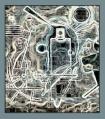
Pete Rollins on Emerging Church exaggerates, but has a point -- not least a theological one: "Be cynical. The original cynics where a dusty group of people who questioned ethics not because they hated ethics but because they loved ethics so much. They questioned God and religion not because they where sceptical but because they where obsessed with God and religion. Questioning God is not questioning God, but only questioning 'God' - in other words our understanding of God. [D]econstruction (which is very cynical) will help revolutionise Western Christianity." (Image: Kandinsky's Deconstruction)
As Tony Kelly CSsR comments: "[T]he demand for a complete self-dispossession pervades the New Testament. Only by losing one's life ... can one truly save it (Matthew 16:24-25; Mark 8:35; Luke 9:24; John 12:25). The moral and spiritual implications of this radical demand have, rightly enough, been the focus of commentators throughout Christian tradition. But there are also implications of a more intellectual character, as faith-inspired thinking seeks to go beyond the conceptual and theoretical systems which, incapable of allowing for ‘God's foolishness', tend to become idolatrous. It is especially here that deconstruction is a bracing reminder ... to take seriously the 'negative theology' of the New Testament."
Comment on this post: FaithInSociety
 A few days ago I raised the question about how one could distinguish between faith and credulity, reason and cynicism. There is, of course, another (more important) definitional take on 'the cynic', referring to the Socratic disdain of the illusions of the world, rather than the corrosive acidity of the modern person who refuses all attempts at truth as politicking.
Pete Rollins on Emerging Church exaggerates, but has a point -- not least a theological one: "Be cynical. The original cynics where a dusty group of people who questioned ethics not because they hated ethics but because they loved ethics so much. They questioned God and religion not because they where sceptical but because they where obsessed with God and religion. Questioning God is not questioning God, but only questioning 'God' - in other words our understanding of God. [D]econstruction (which is very cynical) will help revolutionise Western Christianity." (Image: Kandinsky's Deconstruction)
As Tony Kelly CSsR comments: "[T]he demand for a complete self-dispossession pervades the New Testament. Only by losing one's life ... can one truly save it (Matthew 16:24-25; Mark 8:35; Luke 9:24; John 12:25). The moral and spiritual implications of this radical demand have, rightly enough, been the focus of commentators throughout Christian tradition. But there are also implications of a more intellectual character, as faith-inspired thinking seeks to go beyond the conceptual and theoretical systems which, incapable of allowing for ‘God's foolishness', tend to become idolatrous. It is especially here that deconstruction is a bracing reminder ... to take seriously the 'negative theology' of the New Testament."
Comment on this post: FaithInSociety
Tuesday, September 13, 2005
[182.1] WAKING UP TO A NEW WORLD
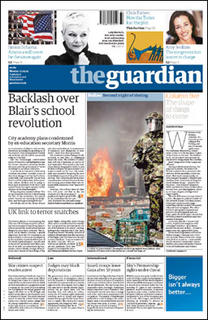 Well, not exactly. But I'm waking up to the new, full-colour, all-singing, all-dancing 'Berliner' format Guardian, anyway -- since the much-hyped relaunch 24 hours ago. This is a subject close to my heart (as I've been reading the Graun for 30 years, and crave good print design too), so I couldn't resist waxing about it in an Ekklesia news/commentary piece yesterday on religion and the newspaper doyen of the liberal intellegentsia. Even those who don't know much about twentieth century theological giant Karl Barth may be aware of his famous comment that Christians should face the world with both scripture and sentinel. As Ronald Goetz commented in The Christian Century during the centenary of his birth, in 1986: "The only aspect of Barth’s thinking that changed little during his lifetime was his politics. Despite the often-repeated charge that his theology led to political quietism, Barth himself was not quiet. He always insisted that theology had to be done with the Bible in one hand and the newspaper in the other. He was a lifelong socialist and political maverick whose political views elicited much hostility -- first in Nazi Germany, later in anticommunist America, and chronically in his own neutral Switzerland. As he once observed, in politics the radical is probably wrong but has a chance of being right; the conservative is [invariably] wrong [emphasis added]." Which is why, I reckon, the Guardian is usually more usefully wrong than the Telegraph, as well as more frequently right.
Comment on this post: FaithInSociety
 Well, not exactly. But I'm waking up to the new, full-colour, all-singing, all-dancing 'Berliner' format Guardian, anyway -- since the much-hyped relaunch 24 hours ago. This is a subject close to my heart (as I've been reading the Graun for 30 years, and crave good print design too), so I couldn't resist waxing about it in an Ekklesia news/commentary piece yesterday on religion and the newspaper doyen of the liberal intellegentsia. Even those who don't know much about twentieth century theological giant Karl Barth may be aware of his famous comment that Christians should face the world with both scripture and sentinel. As Ronald Goetz commented in The Christian Century during the centenary of his birth, in 1986: "The only aspect of Barth’s thinking that changed little during his lifetime was his politics. Despite the often-repeated charge that his theology led to political quietism, Barth himself was not quiet. He always insisted that theology had to be done with the Bible in one hand and the newspaper in the other. He was a lifelong socialist and political maverick whose political views elicited much hostility -- first in Nazi Germany, later in anticommunist America, and chronically in his own neutral Switzerland. As he once observed, in politics the radical is probably wrong but has a chance of being right; the conservative is [invariably] wrong [emphasis added]." Which is why, I reckon, the Guardian is usually more usefully wrong than the Telegraph, as well as more frequently right.
Comment on this post: FaithInSociety
Monday, September 12, 2005
[181.1] HOW THE ONE WAS WEST
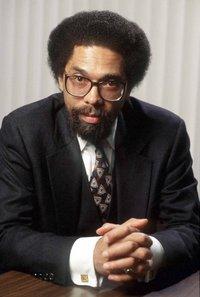 The inimitable Cornel West, professor of African American Studies and Religion at Princeton University, pulls few punches in his post-Katrina interview with Joanna Walters in the Observer newspaper ('Exiles from a city and from a nation'). My introduction to his work was the classic Prophesy Deliverance! An Afro-American Revolutionary Christianity, penned in his 20s. He's also the only theologian I know who's recorded a hip-hop album. There are downloads on his home page. In today's piece, he declares:
"If I had been of Martin Luther King's generation I would never have gone to Harvard or Princeton. They shot brother Martin dead like a dog in 1968 when the mobilisation of the black poor was just getting started. At least one of his surviving legacies was the quadrupling in the size of the black middle class. But Oprah [Winfrey] the billionaire and the black judges and chief executives and movie stars do not mean equality, or even equality of opportunity yet. Black faces in high places does not mean racism is over. Condoleezza Rice has sold her soul. Now the black bourgeoisie have an even heavier obligation to fight for the 33 per cent of black children living in poverty - and to alleviate the spiritual crisis of hopelessness among young black men.
"[President George W. ] Bush talks about God, but he has forgotten the point of prophetic Christianity is compassion and justice for those who have least. Hip-hop has the anger that comes out of post-industrial, free-market America, but it lacks the progressiveness that produces organisations that will threaten the status quo. There has not been a giant since King, someone prepared to ... create an insurgency where many are prepared to die to upset the corporate elite. The Democrats are spineless."
I caught Cornel West in action myself at a public meeting in Brixton (Railton Road Methodist Church, where I had an office in the late '80s) a few years ago. Stirring and sharp, he was, in an oddly predictable way, every inch a black Pentecostal preacher - but one who effortlessly dropped in words like 'hegemony' and 'hermeneutics' in between street anecodes, biblical quotations and impassioned pleas for justice... all to loud choruses of 'amen!' and 'hallellujah!' It was quite an evening.
Then there are those cameo appearances in The Matrix and The Matrix unloaded. Really. Of course West has attracted much criticism for grandstanding, not all of it illegitimate. But he integrates critical faith and progressive politics in a unique, infuriating and inspiring way.
Clarence Shole Johnson explores his conceptions of pragmatism, existentialism, post-Marxism, prophetic Christianity, black-Jewish relations, affirmative action, and the role of black intellectuals in Cornel West and Philosophy (Africana Thought), published by Routledge in 2002. See also the PBS programme, This Far by Faith.
Comment on this post: FaithInSociety
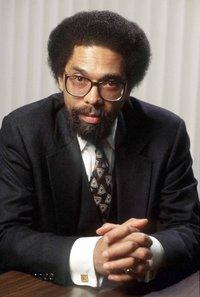 The inimitable Cornel West, professor of African American Studies and Religion at Princeton University, pulls few punches in his post-Katrina interview with Joanna Walters in the Observer newspaper ('Exiles from a city and from a nation'). My introduction to his work was the classic Prophesy Deliverance! An Afro-American Revolutionary Christianity, penned in his 20s. He's also the only theologian I know who's recorded a hip-hop album. There are downloads on his home page. In today's piece, he declares:
"If I had been of Martin Luther King's generation I would never have gone to Harvard or Princeton. They shot brother Martin dead like a dog in 1968 when the mobilisation of the black poor was just getting started. At least one of his surviving legacies was the quadrupling in the size of the black middle class. But Oprah [Winfrey] the billionaire and the black judges and chief executives and movie stars do not mean equality, or even equality of opportunity yet. Black faces in high places does not mean racism is over. Condoleezza Rice has sold her soul. Now the black bourgeoisie have an even heavier obligation to fight for the 33 per cent of black children living in poverty - and to alleviate the spiritual crisis of hopelessness among young black men.
"[President George W. ] Bush talks about God, but he has forgotten the point of prophetic Christianity is compassion and justice for those who have least. Hip-hop has the anger that comes out of post-industrial, free-market America, but it lacks the progressiveness that produces organisations that will threaten the status quo. There has not been a giant since King, someone prepared to ... create an insurgency where many are prepared to die to upset the corporate elite. The Democrats are spineless."
I caught Cornel West in action myself at a public meeting in Brixton (Railton Road Methodist Church, where I had an office in the late '80s) a few years ago. Stirring and sharp, he was, in an oddly predictable way, every inch a black Pentecostal preacher - but one who effortlessly dropped in words like 'hegemony' and 'hermeneutics' in between street anecodes, biblical quotations and impassioned pleas for justice... all to loud choruses of 'amen!' and 'hallellujah!' It was quite an evening.
Then there are those cameo appearances in The Matrix and The Matrix unloaded. Really. Of course West has attracted much criticism for grandstanding, not all of it illegitimate. But he integrates critical faith and progressive politics in a unique, infuriating and inspiring way.
Clarence Shole Johnson explores his conceptions of pragmatism, existentialism, post-Marxism, prophetic Christianity, black-Jewish relations, affirmative action, and the role of black intellectuals in Cornel West and Philosophy (Africana Thought), published by Routledge in 2002. See also the PBS programme, This Far by Faith.
Comment on this post: FaithInSociety
Sunday, September 11, 2005
[180.1] INVOKING A MYSTERY
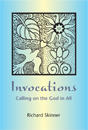 I should have mentioned some time ago that Richard Skinner (a writer, poet, performer, comedian and counsellor - who also happens to attend my church in Exeter, St Stephen's) has recently produced a fine new collection of verse. Invocations: Calling on the God in All (ISBN 1901557936, £5.99) is published by Wild Goose, the associate publishers of the Iona Community in Scotland.
In the tradition of liturgical chants such as the ‘Advent Antiphons’, Richard Skinner has created invocations inspired by creatures, conditions and objects in the world around us which reflect and are a metaphor for aspects of God or the Divine. Although the author comes from a Christian background and is most at home with the iconography and language of Christianity, these invocations, which incorporate symbolism from creation, science, technology and human psychology, and point to the God in all things, will resonate with individuals and groups of any or no particular religious or spiritual allegiance.
An excerpt from the book is viewable in *.PDF format here.
Comment on this post: FaithInSociety
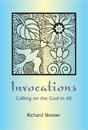 I should have mentioned some time ago that Richard Skinner (a writer, poet, performer, comedian and counsellor - who also happens to attend my church in Exeter, St Stephen's) has recently produced a fine new collection of verse. Invocations: Calling on the God in All (ISBN 1901557936, £5.99) is published by Wild Goose, the associate publishers of the Iona Community in Scotland.
In the tradition of liturgical chants such as the ‘Advent Antiphons’, Richard Skinner has created invocations inspired by creatures, conditions and objects in the world around us which reflect and are a metaphor for aspects of God or the Divine. Although the author comes from a Christian background and is most at home with the iconography and language of Christianity, these invocations, which incorporate symbolism from creation, science, technology and human psychology, and point to the God in all things, will resonate with individuals and groups of any or no particular religious or spiritual allegiance.
An excerpt from the book is viewable in *.PDF format here.
Comment on this post: FaithInSociety
Saturday, September 10, 2005
[179.1] YOUNGER ASIAN VOICES AIM TO MIX IT IN THE MEDIA
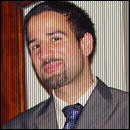 I'm honoured that Sunny Hundal (left), founder of Asians in Media, has linked FaithInSociety on his important new webzine venture, Pickled Politics - which aims to give a range of young, progressive British Asians a stronger voice in the public debate about politics, culture and religion. A background story is here on Ekklesia.
In a piece on Ziauddin Sardar's recent primetime BBC2 documentary Battle for Islam, Hundal wrote: Conservative Asians have a habit of believing that changing religious practice is a bad thing because it is deviating away from the religion. What they don’t realise is that Islam, Sikhism and Hinduism have long traditions of theological debate that encourages re-interpretation of the religious scriptures. This needs to change.
Similar lack of awareness inhabits Christianity, of course, when tradition and scripture are taken to be fixed, restrictive, closed, determined by the past, and prescriptive - rather than dynamic, creative, open, future-oriented, and generative.
Naturally I've added Pickled Politics and AIM to my own blogroll, under newsLinks. They're both essential reading for a different take on life in Britain and beyond.
Comment on this post: FaithInSociety
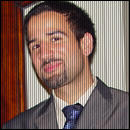 I'm honoured that Sunny Hundal (left), founder of Asians in Media, has linked FaithInSociety on his important new webzine venture, Pickled Politics - which aims to give a range of young, progressive British Asians a stronger voice in the public debate about politics, culture and religion. A background story is here on Ekklesia.
In a piece on Ziauddin Sardar's recent primetime BBC2 documentary Battle for Islam, Hundal wrote: Conservative Asians have a habit of believing that changing religious practice is a bad thing because it is deviating away from the religion. What they don’t realise is that Islam, Sikhism and Hinduism have long traditions of theological debate that encourages re-interpretation of the religious scriptures. This needs to change.
Similar lack of awareness inhabits Christianity, of course, when tradition and scripture are taken to be fixed, restrictive, closed, determined by the past, and prescriptive - rather than dynamic, creative, open, future-oriented, and generative.
Naturally I've added Pickled Politics and AIM to my own blogroll, under newsLinks. They're both essential reading for a different take on life in Britain and beyond.
Comment on this post: FaithInSociety
Friday, September 09, 2005
[178.1] GOD IS NOT A CONVENIENT COMMODITY
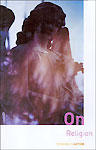 John D. Caputo, in his stimulating book On Religion, and elsewhere, has done much to reinstate to contemporary attention Augustine's central question, "What do we love when we love our God?"
A famous Christian mystic put the issue like this: Some people want to see God with their eyes as they see a cow and to love [God] as they love their cow - they love their cow for the milk and cheese and profit it makes them. This is how it is with people who love God for the sake of outward wealth or inward comfort. They do not rightly love God when they love for their own advantage. Indeed, I tell you the truth, any object you have on your mind, however good, will be a barrier between you and the inmost truth. (Meister Eckhart)
I was sorry to miss hearing John Caputo in Belfast recently. He appeared on BBC Sunday Sequence (listen here), and his talk at Swarthmore was on "The Weakness of God: A Theology of the Event." It is good that emergent-emerging church people are getting interested in what he says, which, among many other things, is that the postmodern returns to religion by positing a "reality" beyond the real (the world of objects and our descriptive reliance on the analogy of being).
See also Vincent Geoghehan's opening up of the debate [in *.PDF format] about post-secularism and religious narrative, specifically the Bible.
Comment on this post: FaithInSociety
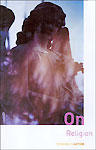 John D. Caputo, in his stimulating book On Religion, and elsewhere, has done much to reinstate to contemporary attention Augustine's central question, "What do we love when we love our God?"
A famous Christian mystic put the issue like this: Some people want to see God with their eyes as they see a cow and to love [God] as they love their cow - they love their cow for the milk and cheese and profit it makes them. This is how it is with people who love God for the sake of outward wealth or inward comfort. They do not rightly love God when they love for their own advantage. Indeed, I tell you the truth, any object you have on your mind, however good, will be a barrier between you and the inmost truth. (Meister Eckhart)
I was sorry to miss hearing John Caputo in Belfast recently. He appeared on BBC Sunday Sequence (listen here), and his talk at Swarthmore was on "The Weakness of God: A Theology of the Event." It is good that emergent-emerging church people are getting interested in what he says, which, among many other things, is that the postmodern returns to religion by positing a "reality" beyond the real (the world of objects and our descriptive reliance on the analogy of being).
See also Vincent Geoghehan's opening up of the debate [in *.PDF format] about post-secularism and religious narrative, specifically the Bible.
Comment on this post: FaithInSociety
Thursday, September 08, 2005
[177.1] ON TRAGEDY BEYOND EXPLANATION
 This astute comment is from Nick Adams' passionate theological manifesto on his home page at New College, University of Edinburgh. (I've had the pleasure of working with Nick, both on the editorial board of the currently suspended Christian magazine, and on the Mission Theological Advisory Group.)
"Increasing numbers of the world's population do not know what to hope for, and find that, for whatever reason, they cannot pray. There are probably complicated reasons for this. There may also be some simple ones. I can think of two. First, our lives are marked by tragedy; second, we are powerless to prevent or explain it. Those who believe that theology should explain tragedy turn away in disappointment. Those who believe that technology or economics should prevent it give up in despair. I think they are right about technology but wrong about theology. Theology is not for explaining tragedy: it's for renewing hope and prayer, and finding deeper and better ways of articulating them. Of course, it's about many other things too. But in a world where [many] people find hoping and praying almost impossible, theologians are going to be busy enough."
As the late Charles E. Winquist argued in his complex and evocative Desiring Theology, the vocation of theology is a work against "the disappointment of thinking" - though ultimately I much prefer Merold Westphal and Robert Scharlemann's take on he challenge than his. (See Westphal's 'Divine Excess: The God Who Comes After' in John D. Caputo, The Religious).
In a different but complementary vein, also in the face of the tragic, Rowan Williams writes: "The childish religious mind… tends to conceive the freedom bestowed on us by God as something provisional and temporary, undergirded by a safety net in the assurance that 'Paternal Love' still reserves the power to bring about its will by force. But what if the divine renunciation of violence is completely serious? In that case, there is no point in wondering whether it is in anger or pity that God stands back from the world or reacts to what the world does; [God] has elected powerlessness in terms of the world."
Williams was reflecting on poetry and the legacy of Bonhoeffer, for whom the God who comes to us is the God who is "edged out of the world onto the cross". There is more to say about this, but not a 'more' that evades that love which chooses to establish itself in and through the terrifying freedom (contigency) of creation. [Quoted in my Is God a disaster area?, which I hope is a tentative account, not "an explanation".]
Comment on this post: FaithInSociety
 This astute comment is from Nick Adams' passionate theological manifesto on his home page at New College, University of Edinburgh. (I've had the pleasure of working with Nick, both on the editorial board of the currently suspended Christian magazine, and on the Mission Theological Advisory Group.)
"Increasing numbers of the world's population do not know what to hope for, and find that, for whatever reason, they cannot pray. There are probably complicated reasons for this. There may also be some simple ones. I can think of two. First, our lives are marked by tragedy; second, we are powerless to prevent or explain it. Those who believe that theology should explain tragedy turn away in disappointment. Those who believe that technology or economics should prevent it give up in despair. I think they are right about technology but wrong about theology. Theology is not for explaining tragedy: it's for renewing hope and prayer, and finding deeper and better ways of articulating them. Of course, it's about many other things too. But in a world where [many] people find hoping and praying almost impossible, theologians are going to be busy enough."
As the late Charles E. Winquist argued in his complex and evocative Desiring Theology, the vocation of theology is a work against "the disappointment of thinking" - though ultimately I much prefer Merold Westphal and Robert Scharlemann's take on he challenge than his. (See Westphal's 'Divine Excess: The God Who Comes After' in John D. Caputo, The Religious).
In a different but complementary vein, also in the face of the tragic, Rowan Williams writes: "The childish religious mind… tends to conceive the freedom bestowed on us by God as something provisional and temporary, undergirded by a safety net in the assurance that 'Paternal Love' still reserves the power to bring about its will by force. But what if the divine renunciation of violence is completely serious? In that case, there is no point in wondering whether it is in anger or pity that God stands back from the world or reacts to what the world does; [God] has elected powerlessness in terms of the world."
Williams was reflecting on poetry and the legacy of Bonhoeffer, for whom the God who comes to us is the God who is "edged out of the world onto the cross". There is more to say about this, but not a 'more' that evades that love which chooses to establish itself in and through the terrifying freedom (contigency) of creation. [Quoted in my Is God a disaster area?, which I hope is a tentative account, not "an explanation".]
Comment on this post: FaithInSociety
Wednesday, September 07, 2005
[176.1] EYELESS IN ALABAMA
Good piece on OpenDemocracy by Geoff Hodgson on the aftermath of the storm and the challenge to democratic politics. Meanwhile the progressive inter-religious coalition FaithfulAmerica (note the penchant for conjoining words in titles!) has raised US$40,000 online for Church World Service's relief efforts.
A friend living in the proximity of the devastation wreaked by Hurricane Katrina wrote to me yesterday: "The enormity and proximity of the disaster are having a profound effecton everybody. This time it is going to take much more than money... Huntsville, Alabama, is now home to hundreds of evacuees and I assume that number will grow."
"We had high winds from the storm but little rain. A big tree fell down in my back yard and I was without power for two days, plus I had to pay for the electrical repairs myself and get the tree moved but all that is inconsequential. My neighbours have been wonderfully helpful.
"The lack of preparedness and sluggish response in the face of one of the big three predicted events defies belief and will be to this country'sundying shame. There will be repercussions ranging from the price of gas and bananas to a review of the health care system and environmental management. But I don't have high hopes of any real reform."
See also this good comment from The New Yorker, In the ruins.
Comment on this post: FaithInSociety
Good piece on OpenDemocracy by Geoff Hodgson on the aftermath of the storm and the challenge to democratic politics. Meanwhile the progressive inter-religious coalition FaithfulAmerica (note the penchant for conjoining words in titles!) has raised US$40,000 online for Church World Service's relief efforts.
A friend living in the proximity of the devastation wreaked by Hurricane Katrina wrote to me yesterday: "The enormity and proximity of the disaster are having a profound effecton everybody. This time it is going to take much more than money... Huntsville, Alabama, is now home to hundreds of evacuees and I assume that number will grow."
"We had high winds from the storm but little rain. A big tree fell down in my back yard and I was without power for two days, plus I had to pay for the electrical repairs myself and get the tree moved but all that is inconsequential. My neighbours have been wonderfully helpful.
"The lack of preparedness and sluggish response in the face of one of the big three predicted events defies belief and will be to this country'sundying shame. There will be repercussions ranging from the price of gas and bananas to a review of the health care system and environmental management. But I don't have high hopes of any real reform."
See also this good comment from The New Yorker, In the ruins.
Comment on this post: FaithInSociety
Tuesday, September 06, 2005
[175.1] REKINDLING THE CRITICAL URBAN SPIRIT
 The Archbishop of Canterbury, Dr Rowan Williams, has just returned from holiday with an interesting piece on Urbanisation, the Christian Church and the Human Project in this week's Church of England Newspaper. Unfortunately it cuts off the last sentence (unless they have corrected it by the time you read this). Among the issues he raises is the question of spirituality in the urban environment.
"[T]he education of the spirit is inseparably bound to highly practical challenges. We still treat separate zoning as unquestionable; we still design residential areas without visible points of focus, as if they were just an assembly of individual residences; we still struggle to get spiritual health onto the agenda of groups planning and discussing regeneration. We have some way to go.
"We need to rescue ‘spirituality’ from some of the ways in which it has been domesticated, even trivialised, in recent years. A popular and a vague word, it demands – especially for the Christian – an anchorage in some specific convictions about human beings and their possibilities. Without this, it becomes only a code for techniques of making people feel a bit better about themselves; whereas the life of the spirit ought also to make people uncomfortable about themselves and their environment, critical and creative, open to things being different. [my emphasis and links added]
"The image of the City of God makes some sense. To the extent that urban life represents, in the history of human culture, a move beyond the sheer struggle for self-sufficiency, a move towards diversified community and a sharpened sense of the variety of goods (material, intellectual, imaginative) that people can exchange with each other, it is an appropriate metaphor for Christian community."
This is good stuff. But confronted with the squalor and division that has recently been unmasked in New Orleans, it still looks like a rather polite 'progressive establishment' take on things. For a gritty, complementary exposition of the challenges arising from the conflictual side of city life, a crucial issue for any spirituality that takes the disturbance of Jesus seriously, see also Kenneth Leech's talk on Ministry, Marginality and Mammon. For those who may not know, UNLEASH is a churches' homeless action network operating across London.
[The skyline depicted is New York's, from where Rowan Williams began to sift ideas for his superb meditation, Writing in the Dust, in the immediate aftermath of 9/11. He was a block or two away when the planes struck.]
Comment on this post: FaithInSociety
 The Archbishop of Canterbury, Dr Rowan Williams, has just returned from holiday with an interesting piece on Urbanisation, the Christian Church and the Human Project in this week's Church of England Newspaper. Unfortunately it cuts off the last sentence (unless they have corrected it by the time you read this). Among the issues he raises is the question of spirituality in the urban environment.
"[T]he education of the spirit is inseparably bound to highly practical challenges. We still treat separate zoning as unquestionable; we still design residential areas without visible points of focus, as if they were just an assembly of individual residences; we still struggle to get spiritual health onto the agenda of groups planning and discussing regeneration. We have some way to go.
"We need to rescue ‘spirituality’ from some of the ways in which it has been domesticated, even trivialised, in recent years. A popular and a vague word, it demands – especially for the Christian – an anchorage in some specific convictions about human beings and their possibilities. Without this, it becomes only a code for techniques of making people feel a bit better about themselves; whereas the life of the spirit ought also to make people uncomfortable about themselves and their environment, critical and creative, open to things being different. [my emphasis and links added]
"The image of the City of God makes some sense. To the extent that urban life represents, in the history of human culture, a move beyond the sheer struggle for self-sufficiency, a move towards diversified community and a sharpened sense of the variety of goods (material, intellectual, imaginative) that people can exchange with each other, it is an appropriate metaphor for Christian community."
This is good stuff. But confronted with the squalor and division that has recently been unmasked in New Orleans, it still looks like a rather polite 'progressive establishment' take on things. For a gritty, complementary exposition of the challenges arising from the conflictual side of city life, a crucial issue for any spirituality that takes the disturbance of Jesus seriously, see also Kenneth Leech's talk on Ministry, Marginality and Mammon. For those who may not know, UNLEASH is a churches' homeless action network operating across London.
[The skyline depicted is New York's, from where Rowan Williams began to sift ideas for his superb meditation, Writing in the Dust, in the immediate aftermath of 9/11. He was a block or two away when the planes struck.]
Comment on this post: FaithInSociety
Monday, September 05, 2005
[174.1] BLAME RACISM AND NEGLECT, NOT GOD
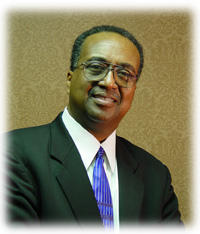 The national president of the Southern Christian Leadership Conference, founded by Dr Martin Luther King, has spoken out strongly on BBC Radio 4's Sunday Programme, calling for a renewed civil rights drive across the USA in the wake of Hurricane Katrina. The radio excerpt is here. Black church and community leaders, including Jesse Jackson, have pointed out that poverty, inequality and racism are clearly implicated in the failure of the federal goverment to deal adequately with the widely-predicted disaster. Journalist Matt Wells has also written a pointed and passionate viewpoint on this and related concerns, 'New Orleans crisis shames US'.
Responding to questions about how God could have allowed such terrible suffering, characterised by fundamentalists as divine punishment, and callously pounced on by some evangelists, SCLC's Charles Steel (left) said: “God has given us everything we need, and we cannot cop out by putting the blame on God.” Indeed. Injustice doesn't drop from heaven, it is very much forged on earth.
I have previously written about the theological issues raised by natural disasters. This is a question which needs much more serious attention by the churches, who rather easily resort to sentiment or cliche in such circumstances. One natural response among those speaking on behalf on the Christian community is to stress divine engagement with suffering, which is surely right. A good, compassionate example is Katherine Torrance's sermon. But it could also be interpreted as a convenient evasion to appear to be attributing the positive to God while sidestepping the negative (though I'm certainly not suggesting that this is what Katherine is intending in her appropriately pastoral approach.)
Meanwhile, in terms of practical response, the US-wide ecumenical relief body Church World Service has also been playing a major role in coordinating aid efforts by faith communities, as have smaller bodies like Mennonite Disaster Service. [Dollar contributions to the SCLC Hurricane Katrina Relief Fund may also be sent to: SCLC National Headquarters, PO Box 89128, 591-A Edgewood Avenue, Atlanta, GA 30312, USA.]
Comment on this post: FaithInSociety
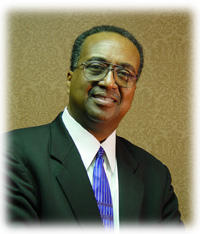 The national president of the Southern Christian Leadership Conference, founded by Dr Martin Luther King, has spoken out strongly on BBC Radio 4's Sunday Programme, calling for a renewed civil rights drive across the USA in the wake of Hurricane Katrina. The radio excerpt is here. Black church and community leaders, including Jesse Jackson, have pointed out that poverty, inequality and racism are clearly implicated in the failure of the federal goverment to deal adequately with the widely-predicted disaster. Journalist Matt Wells has also written a pointed and passionate viewpoint on this and related concerns, 'New Orleans crisis shames US'.
Responding to questions about how God could have allowed such terrible suffering, characterised by fundamentalists as divine punishment, and callously pounced on by some evangelists, SCLC's Charles Steel (left) said: “God has given us everything we need, and we cannot cop out by putting the blame on God.” Indeed. Injustice doesn't drop from heaven, it is very much forged on earth.
I have previously written about the theological issues raised by natural disasters. This is a question which needs much more serious attention by the churches, who rather easily resort to sentiment or cliche in such circumstances. One natural response among those speaking on behalf on the Christian community is to stress divine engagement with suffering, which is surely right. A good, compassionate example is Katherine Torrance's sermon. But it could also be interpreted as a convenient evasion to appear to be attributing the positive to God while sidestepping the negative (though I'm certainly not suggesting that this is what Katherine is intending in her appropriately pastoral approach.)
Meanwhile, in terms of practical response, the US-wide ecumenical relief body Church World Service has also been playing a major role in coordinating aid efforts by faith communities, as have smaller bodies like Mennonite Disaster Service. [Dollar contributions to the SCLC Hurricane Katrina Relief Fund may also be sent to: SCLC National Headquarters, PO Box 89128, 591-A Edgewood Avenue, Atlanta, GA 30312, USA.]
Comment on this post: FaithInSociety
Sunday, September 04, 2005
[173.1] THE AGONY OF HOPE
 "[W]hen we take human existence upon ourselves in its starkest and most humiliating misery—a misery in which nothing, really nothing, has meaning—[then] we can win through to the only possible way to live. The first step is to grasp human destiny in its deepest contradiction… A genuine feeling for life will show a person the deepest contrast between extreme happiness and extreme pain. It is only when we taste the lot of all, when we become involved deeply in world suffering, one in heart with the need of [humanity], that we can win through to that vocation which is the calling of [human beings], and which, therefore, [is true] joy… Only when the conscience becomes active, only when love is born out of suffering, only when hardship leads to liberating action, is victory near." (Eberhard Arnold, from a lecture held in Berlin, 7 April, 1919. )
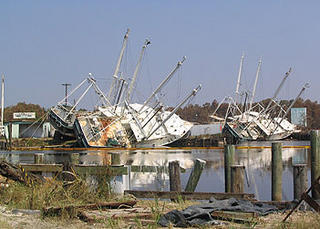
Picture: coutesy of Mennonite Disaster Service. The main canal leading into the town of Bayou La Batre, Alabama, where three-quarters of the town was destroyed by Hurricane Katrina's floodwaters. Donate to MDS here.
Comment on this post: FaithInSociety
 "[W]hen we take human existence upon ourselves in its starkest and most humiliating misery—a misery in which nothing, really nothing, has meaning—[then] we can win through to the only possible way to live. The first step is to grasp human destiny in its deepest contradiction… A genuine feeling for life will show a person the deepest contrast between extreme happiness and extreme pain. It is only when we taste the lot of all, when we become involved deeply in world suffering, one in heart with the need of [humanity], that we can win through to that vocation which is the calling of [human beings], and which, therefore, [is true] joy… Only when the conscience becomes active, only when love is born out of suffering, only when hardship leads to liberating action, is victory near." (Eberhard Arnold, from a lecture held in Berlin, 7 April, 1919. )
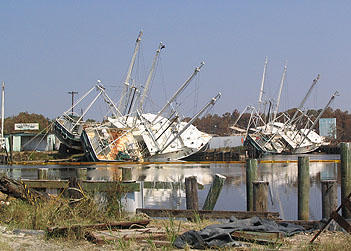
Picture: coutesy of Mennonite Disaster Service. The main canal leading into the town of Bayou La Batre, Alabama, where three-quarters of the town was destroyed by Hurricane Katrina's floodwaters. Donate to MDS here.
Comment on this post: FaithInSociety
Saturday, September 03, 2005
[172.1] TRUMPING THE SUBLIME WITH THE RIDICULOUS
People sometimes ask me why I don't write about headliners like the Da Vinci Code (Doubleday, 2003), the Bible Code and so on. Heaven knows why, but they do. I obviously don't strike them as having anything better to do! But seriously... In post-Christian and radically plural societies, the amount of pulp from (or about) religion seems never-ending, and it strikes me as a time-consuming miscalculation to think that people eager for this stuff are likely to be swayed by earnest attempts to trump the ridiculous with the sublime.
Regarding Michael Drosnin, the best retort is surely satire: see, for instance, Pete Aitken's 'playing with the Bible or playing with ourselves'. As far as Dan Brown is concerned, a friend recently told me he found one of the multi-millionaire's books idly abandoned in an airport arrivals lounge, and after only ten minutes could scarcely credit how badly written and tedious it was. "Thank goodness", he sighed. "It could have been far worse. I could have paid for it."
Meanwhile, Robert M. Price has a volume coming out soon called The Da Vinci Fraud, which I imagine will be a good a hachet job. He says: "There exists a surprisingly large public for books that claim to 'blow the lid off Christianity' by means of new discoveries, real or imagined. Many such readers are what one might call sophomoric skeptics. They have learned proper suspicion toward their inherited Christian faith, but they seem to be completely uncritical about the assertions of those who would substitute some other hypothesis, often equally wild ... The Da Vinci Code [...] is a fictional narrative, but its author claims it is based on fact. That, too, alas, is part of the fiction."
Price himself started out as a Bible-belt fundamentalist, and has gradually morphed into a born-again nonbeliever who dismisses Christianity (with comparable nineteenth century rationalist fervour) as a "wild" Hellenistic mystery cult, though he still appreciates its rituals. So while he's an entertaining writer, and given the right target can score a high number of palpable hits, his approach is overdetermined by an exaggerated counter-image of what he opposes.
From an equally passionate contending viewpoint, this time Catholic, journalist Sandra Miesel (who co-authored The Da Vinci Hoax with Carl E. Olson) offers a deconstruction of the bestseller in that odd mix which is Crisis magazine ("politics, culture and church"). As she says: "In the end, Dan Brown has penned a poorly written, atrociously researched mess."
True. And that, frankly, ought to suffice to encourage us to focus on something else. For example the question about what distinguishes proper skepticism and trust (we surely need both to sustain a healthy life?) and improper versions of these (otherwise known as cynicism and credulity) which turn out to be seriously disabling.
Comment on this post: FaithInSociety
People sometimes ask me why I don't write about headliners like the Da Vinci Code (Doubleday, 2003), the Bible Code and so on. Heaven knows why, but they do. I obviously don't strike them as having anything better to do! But seriously... In post-Christian and radically plural societies, the amount of pulp from (or about) religion seems never-ending, and it strikes me as a time-consuming miscalculation to think that people eager for this stuff are likely to be swayed by earnest attempts to trump the ridiculous with the sublime.
Regarding Michael Drosnin, the best retort is surely satire: see, for instance, Pete Aitken's 'playing with the Bible or playing with ourselves'. As far as Dan Brown is concerned, a friend recently told me he found one of the multi-millionaire's books idly abandoned in an airport arrivals lounge, and after only ten minutes could scarcely credit how badly written and tedious it was. "Thank goodness", he sighed. "It could have been far worse. I could have paid for it."
Meanwhile, Robert M. Price has a volume coming out soon called The Da Vinci Fraud, which I imagine will be a good a hachet job. He says: "There exists a surprisingly large public for books that claim to 'blow the lid off Christianity' by means of new discoveries, real or imagined. Many such readers are what one might call sophomoric skeptics. They have learned proper suspicion toward their inherited Christian faith, but they seem to be completely uncritical about the assertions of those who would substitute some other hypothesis, often equally wild ... The Da Vinci Code [...] is a fictional narrative, but its author claims it is based on fact. That, too, alas, is part of the fiction."
Price himself started out as a Bible-belt fundamentalist, and has gradually morphed into a born-again nonbeliever who dismisses Christianity (with comparable nineteenth century rationalist fervour) as a "wild" Hellenistic mystery cult, though he still appreciates its rituals. So while he's an entertaining writer, and given the right target can score a high number of palpable hits, his approach is overdetermined by an exaggerated counter-image of what he opposes.
From an equally passionate contending viewpoint, this time Catholic, journalist Sandra Miesel (who co-authored The Da Vinci Hoax with Carl E. Olson) offers a deconstruction of the bestseller in that odd mix which is Crisis magazine ("politics, culture and church"). As she says: "In the end, Dan Brown has penned a poorly written, atrociously researched mess."
True. And that, frankly, ought to suffice to encourage us to focus on something else. For example the question about what distinguishes proper skepticism and trust (we surely need both to sustain a healthy life?) and improper versions of these (otherwise known as cynicism and credulity) which turn out to be seriously disabling.
Comment on this post: FaithInSociety
Friday, September 02, 2005
[171.1] CHANGING THE CLIMATE ON ENVIRONMENTAL ACTION
 [Updated 03.09.05] The scenes and reports from Louisiana and Mississippi on the TV a few hours ago were appalling. In New Orleans, thousands of poor (mainly black) people were unable to evacuate the city as instructed because they did not have the requisite money or transport. They also have little or no medical or property insurance. So prospects beyond the immediate mess are bleak, too. Though Hurricane Katrina is classed as a natural disaster (by all but some malign fundamentalists), its differential impact poignantly illustrates the ongoing pain of 'the other America' - the one that has neither the resources nor the inclination to go to war, but which faces a daily struggle for survival. Federal support of US$10.5 billion has now been pledged. But how, when, in what form (and for whom) it will turn up is a different question. It has taken five days even for basic food and provisions to arrive.
The fact that New Orleans is the conduit for half the country's oil and gas supplies will certainly make a difference to a goverment otherwise reluctant to spend public money. Oil price hikes and a possible US$100 billion economic hole will see to that. But Katrina also raises deep questions about the environmental implications of coastal reclamation developments of this kind. And, of course, it highlights the urgency of tackling climate change, which the Bush administration still refuses to face up to.
By a positive piece of synchronicity (since it was planned weeks ago), representatives of Christian Aid, CAFOD (the Catholic Agency for Overseas Development) and Tearfund took part in the dramatic launch of a new climate change campaign – Stop Climate Chaos – in central London yesterday.
Around 500 campaigners lay down in front of the oil company Shell’s UK headquarters, near the south bank of the Thames, to form the swirling shape of the ‘Stop Climate Chaos’ logo (see graphic).
"It's curious to be asked to lie in the park during a morning at work, but there’s little campaigners won’t do to draw attention to their cause," declared Paul Valentin, Christian Aid’s international director, whose body formed part of the logo. [Full story on Ekklesia]
Comment on this post: FaithInSociety
 [Updated 03.09.05] The scenes and reports from Louisiana and Mississippi on the TV a few hours ago were appalling. In New Orleans, thousands of poor (mainly black) people were unable to evacuate the city as instructed because they did not have the requisite money or transport. They also have little or no medical or property insurance. So prospects beyond the immediate mess are bleak, too. Though Hurricane Katrina is classed as a natural disaster (by all but some malign fundamentalists), its differential impact poignantly illustrates the ongoing pain of 'the other America' - the one that has neither the resources nor the inclination to go to war, but which faces a daily struggle for survival. Federal support of US$10.5 billion has now been pledged. But how, when, in what form (and for whom) it will turn up is a different question. It has taken five days even for basic food and provisions to arrive.
The fact that New Orleans is the conduit for half the country's oil and gas supplies will certainly make a difference to a goverment otherwise reluctant to spend public money. Oil price hikes and a possible US$100 billion economic hole will see to that. But Katrina also raises deep questions about the environmental implications of coastal reclamation developments of this kind. And, of course, it highlights the urgency of tackling climate change, which the Bush administration still refuses to face up to.
By a positive piece of synchronicity (since it was planned weeks ago), representatives of Christian Aid, CAFOD (the Catholic Agency for Overseas Development) and Tearfund took part in the dramatic launch of a new climate change campaign – Stop Climate Chaos – in central London yesterday.
Around 500 campaigners lay down in front of the oil company Shell’s UK headquarters, near the south bank of the Thames, to form the swirling shape of the ‘Stop Climate Chaos’ logo (see graphic).
"It's curious to be asked to lie in the park during a morning at work, but there’s little campaigners won’t do to draw attention to their cause," declared Paul Valentin, Christian Aid’s international director, whose body formed part of the logo. [Full story on Ekklesia]
Comment on this post: FaithInSociety
Thursday, September 01, 2005
[170.1] DANCING ON THE GRAVE OF LOUISIANA'S TRAGEDY
 As if things weren't bad enough for the many people killed, injured or made destitute by Hurricane Katrina in and around New Orleans, Louisiana, they also have to endure aggressive religious conservatives claiming it as a divine handiwork. The religious right in the US and elsewhere does irreparable damage to Christianity by fostering the idea in the public imagination that the capricious deity they bow to is somehow connected with the God of Jesus Christ - who, far from employing crucifying vengeance, actually absorbs, negates and transforms it.
The spin that people like Pat Robertson, Jerry Falwell and 'Repent America' put on public tragedy is therefore not spiritual but ideological, and in any meaningful sense (bound up with the struggle of life against death) is profoundly anti-theological. For while it often adopts a correspondingly trenchant anti-Muslim rhetoric, its central convictions are just as brutal and hate-filled as the distortions of extreme Islamism.
In its own way, it is also bound up with the murderous myth of redemptive violence, which subsumes biblical categories into an active belief in annihilation as cleansing ritual. Of course it can find plenty of textual legitimation for this, but only by eschewing the hermeneutical counter-story and lived reality of Jesus -- a redeeming narrative about humanity released from the ideological power of death in face of a God who is quite unlike our dominant ideas of 'godness'. (See 'Does Christianity kill or cure?')
Meanwhile, some are describing these events as 'America's tsunami'. This is inappropriate for a host of reasons. Awful though it is, there was warning, and an immeasurably wealthier society has the capacity to recover much more effectively in the long-run. That said, it is predictable and notable that those worst effected in both cases are the poorest.
And in both instances, the deeper question arises for many people of faith: is God a disaster area?
Comment on this post: FaithInSociety
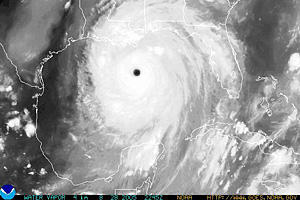
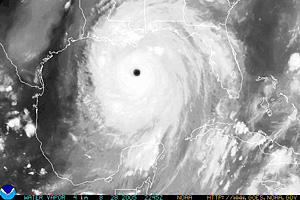 As if things weren't bad enough for the many people killed, injured or made destitute by Hurricane Katrina in and around New Orleans, Louisiana, they also have to endure aggressive religious conservatives claiming it as a divine handiwork. The religious right in the US and elsewhere does irreparable damage to Christianity by fostering the idea in the public imagination that the capricious deity they bow to is somehow connected with the God of Jesus Christ - who, far from employing crucifying vengeance, actually absorbs, negates and transforms it.
The spin that people like Pat Robertson, Jerry Falwell and 'Repent America' put on public tragedy is therefore not spiritual but ideological, and in any meaningful sense (bound up with the struggle of life against death) is profoundly anti-theological. For while it often adopts a correspondingly trenchant anti-Muslim rhetoric, its central convictions are just as brutal and hate-filled as the distortions of extreme Islamism.
In its own way, it is also bound up with the murderous myth of redemptive violence, which subsumes biblical categories into an active belief in annihilation as cleansing ritual. Of course it can find plenty of textual legitimation for this, but only by eschewing the hermeneutical counter-story and lived reality of Jesus -- a redeeming narrative about humanity released from the ideological power of death in face of a God who is quite unlike our dominant ideas of 'godness'. (See 'Does Christianity kill or cure?')
Meanwhile, some are describing these events as 'America's tsunami'. This is inappropriate for a host of reasons. Awful though it is, there was warning, and an immeasurably wealthier society has the capacity to recover much more effectively in the long-run. That said, it is predictable and notable that those worst effected in both cases are the poorest.
And in both instances, the deeper question arises for many people of faith: is God a disaster area?
Comment on this post: FaithInSociety
Subscribe to:
Posts (Atom)